
Have you ever looked at a prescription bottle and wondered why your medication is grouped the way it is? You might see terms like "Schedule II" or "Tier 1 Generic," but what do they actually mean for your health and wallet? Understanding generic drug classifications isn't just academic-it helps you navigate insurance costs, avoid dangerous interactions, and understand exactly how your medicine works in your body.
Drugs aren't just sorted randomly on pharmacy shelves. They are categorized using several distinct systems that serve different purposes. Some systems focus on what disease the drug treats, others on how it interacts with cells, and some on legal restrictions. By July 2026, these systems have evolved to handle complex new treatments, but the core frameworks remain essential for healthcare providers worldwide.
The Main Systems of Drug Classification
There is no single list that defines every drug. Instead, we rely on a few major frameworks. Each one answers a different question about the medication.
- Therapeutic Classification: What condition does this drug treat?
- Pharmacologic Classification: How does this drug work biologically?
- Legal/Scheduling Classification: How strictly is this drug controlled by law?
- Insurance Tier Classification: How much will this drug cost me?
- Anatomical Therapeutic Chemical (ATC) System: How is this drug categorized globally?
Let's break down each system so you can see how they apply to your daily life.
Therapeutic Classification: Treating the Condition
This is the most common way doctors think about medications. It groups drugs by the medical condition they address. If you have high blood pressure, your doctor looks for "Cardiovascular Agents." If you have pain, they look for "Analgesics."
The Food and Drug Administration (FDA) and the United States Pharmacopeia (USP) maintain the primary model for this in the U.S. As of their 2023 guidelines, this system organizes drugs into broad categories like:
- Analgesics: Pain relievers, further split into non-opioid (like ibuprofen) and opioid (like oxycodone).
- Antineoplastics: Drugs used to treat cancer.
- Endocrine Agents: Medications affecting hormones, such as insulin for diabetes.
- Central Nervous System Agents: Drugs affecting the brain, including antidepressants and antipsychotics.
Why does this matter to you? Because therapeutic classification helps prevent errors. A study by the American Society of Health-System Pharmacists (ASHP) found that standardized therapeutic labels reduced medication errors by 31% in hospitals. When nurses and doctors use the same language-saying "beta-blocker" instead of a random chemical name-patients get safer care.
However, this system has a flaw. Many drugs treat more than one thing. Take aspirin. Is it an analgesic (pain reliever)? Yes. Is it an anticoagulant (blood thinner)? Also yes. This dual nature can sometimes cause confusion in electronic health records if the system only allows one category per drug.
Pharmacologic Classification: The Mechanism of Action
While therapeutic classification asks "what does it cure?", pharmacologic classification asks "how does it work?" This system groups drugs by their biological mechanism. For example, it might group all drugs that block epidermal growth factor receptors together, even if they treat different types of cancer.
This approach is highly scientific. According to the National Center for Biotechnology Information (NCBI), there are over 1,200 distinct pharmacologic classes identified in current literature. This precision is vital for researchers and specialists but can be overwhelming for general practitioners.
Consider kinase inhibitors. There are 217 distinct types, all grouped under "Molecular Target Inhibitors." They treat various cancers by stopping specific cell signals. A doctor needs to know the specific mechanism to avoid giving two drugs that fight against each other in the body. However, for a patient picking up a script, knowing a drug is a "partial mu-opioid agonist" tells them less than knowing it's a "painkiller."
Legal Scheduling: The DEA Controlled Substances Act
In the United States, the Drug Enforcement Administration (DEA) classifies drugs based on their potential for abuse and their accepted medical use. This is known as the "Scheduling" system, established in 1970. It has five schedules:
| Schedule | Abuse Potential | Medical Use | Examples |
|---|---|---|---|
| Schedule I | High | No accepted medical use | Heroin, LSD, Marijuana (federally) |
| Schedule II | High | Accepted medical use | Oxycodone, Fentanyl, Adderall |
| Schedule III | Moderate to Low | Accepted medical use | Buprenorphine, Anabolic steroids |
| Schedule IV | Low | Accepted medical use | Xanax, Valium |
| Schedule V | Lowest | Accepted medical use | Cough syrups with low codeine |
This system creates strict rules for prescribing. Schedule II drugs, for instance, cannot be refilled without a new prescription. Critics argue the system is outdated. Dr. Nora Volkow, Director of the National Institute on Drug Abuse, has pointed out that labeling marijuana as Schedule I hinders research, despite its medical benefits being recognized in many states. As of late 2023, legislative efforts to reschedule marijuana continued, which could shift how these drugs are classified and accessed in the near future.
Insurance Tiers: The Cost Factor
For most patients, the most immediate classification is the insurance tier. Insurance companies like Humana divide drugs into tiers to manage costs. This isn't about biology; it's about economics.
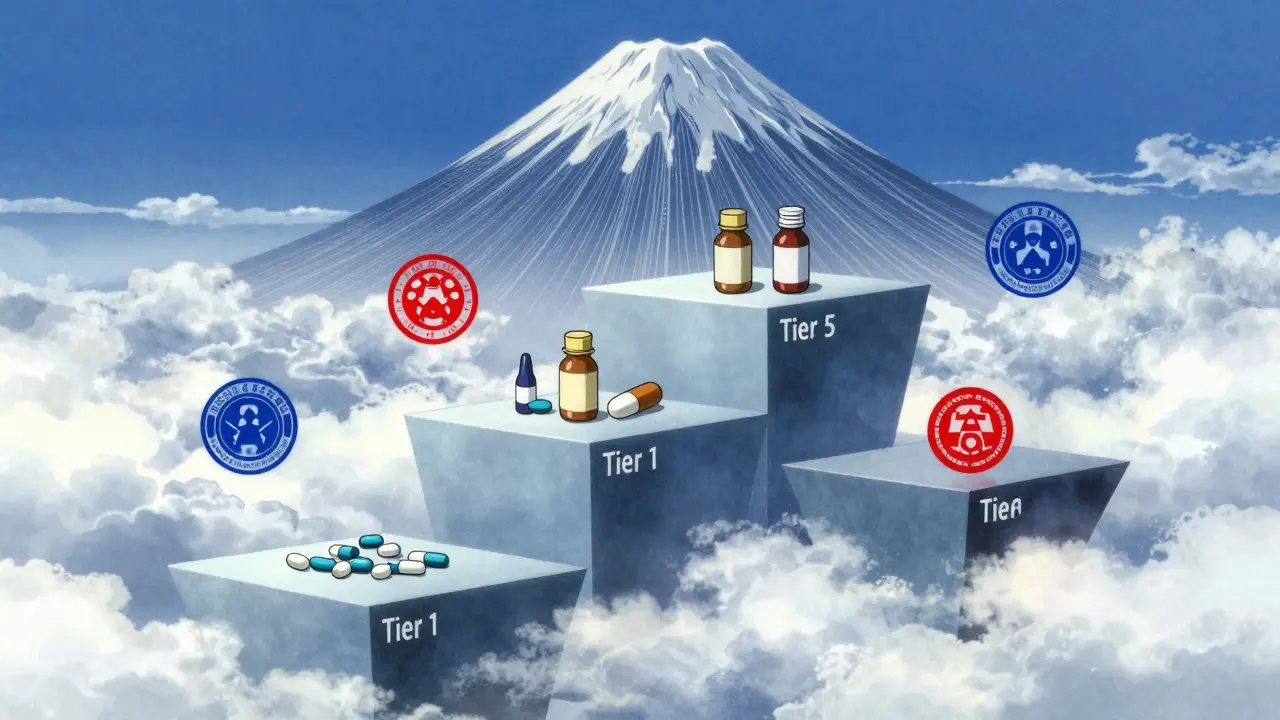
- Tier 1: Preferred generics. These are the cheapest options, covering about 75% of generic drugs.
- Tier 2: Non-preferred generics. Slightly higher copay.
- Tier 3: Preferred brand-name drugs.
- Tier 4: Non-preferred brand-name drugs.
- Tier 5: Specialty medications. These are high-cost drugs for complex conditions.
A frustrating reality for patients is that two generic versions of the same drug might end up in different tiers. One might be Tier 1, while another identical generic is Tier 2 due to contracts between the manufacturer and the insurance plan. Pharmacists report that disputes over these tiers account for nearly half of prior authorization requests. Always ask your pharmacist if a cheaper tier alternative exists for your prescribed medication.
Global Standardization: The ATC System
Outside the U.S., or when looking at global health data, the World Health Organization (WHO) uses the Anatomical Therapeutic Chemical (ATC) classification system. It categorizes drugs by the part of the body they affect (Anatomical), their medical purpose (Therapeutic), and their chemical structure (Chemical).
The ATC system covers over 5,000 substances across 14 main anatomical groups. It is used by 143 countries. This standardization allows researchers to compare drug usage patterns worldwide. For example, they can track how many people in Europe versus Asia are taking proton pump inhibitors for acid reflux. The WHO updates this list regularly, adding hundreds of new codes annually to keep pace with new drug approvals.
The Power of Stem Naming
You don't need a database to guess a drug's class if you know its name. The USP adopted a stem naming convention in 1964 that embeds classification info directly into the generic name. This has been shown to reduce medication errors by 18%.
Here are some common stems you might recognize:
- -lol: Beta-blockers (e.g., propranolol, metoprolol). Used for heart conditions.
- -prazole: Proton pump inhibitors (e.g., omeprazole, pantoprazole). Used for acid reflux.
- -statin: HMG-CoA reductase inhibitors (e.g., atorvastatin, simvastatin). Used for cholesterol.
- -cillin: Penicillins (e.g., amoxicillin). Antibiotics.
Knowing these suffixes helps you spot similar drugs and discuss alternatives with your doctor confidently. If you react badly to one "-statin," your doctor knows to switch you to a different one in the same class rather than trying a completely unrelated drug.
Challenges and Future Trends
As medicine advances, these old boxes are getting crowded. Modern drugs often work in multiple ways simultaneously. By 2028, experts predict that 65% of new molecular entities will have multimodal mechanisms, meaning they don't fit neatly into one pharmacologic class.
The FDA responded by launching "Therapeutic Categories Model 2.0" in late 2023. This update allows for primary and secondary indications, acknowledging that a drug might primarily treat cancer but secondarily affect inflammation. Additionally, AI-driven tools are emerging to help classify these complex drugs. IBM Watson Health and other platforms now use machine learning to predict optimal therapeutic placement with high accuracy.
Despite these tech upgrades, human expertise remains crucial. Doctors still spend significant time navigating conflicting classifications. A 2022 survey found that nearly 80% of primary care physicians spend 12-18 minutes per patient dealing with these classification nuances. Understanding the basics empowers you to participate in those conversations, ensuring you get the right drug at the right price.
What is the difference between therapeutic and pharmacologic classification?
Therapeutic classification groups drugs by the disease or condition they treat (e.g., "antihypertensives" for high blood pressure). Pharmacologic classification groups drugs by how they work in the body at a biological level (e.g., "ACE inhibitors"). A drug can belong to the same therapeutic class but have different pharmacologic mechanisms.
Why are some generic drugs more expensive than others?
Insurance companies place drugs into "tiers." Even though two drugs may contain the same active ingredient, one might be in Tier 1 (preferred) and another in Tier 2 (non-preferred) due to pricing contracts between manufacturers and insurers. This results in different copays for the patient.
What does it mean if a drug is Schedule II?
Under the DEA Controlled Substances Act, Schedule II drugs have a high potential for abuse but also have an accepted medical use. Examples include oxycodone and Adderall. These drugs require a new prescription for each refill and cannot be renewed via phone.
How can I tell what class of drug I am taking?
Look at the generic name's suffix. Stems like "-lol" indicate beta-blockers, "-prazole" indicates proton pump inhibitors, and "-statin" indicates cholesterol-lowering drugs. Your prescription label or the Patient Information Leaflet inside the box will also state the drug class.
Is the ATC system used in the United States?
The ATC system is primarily used internationally by the WHO. In the U.S., the FDA and USP therapeutic classification models are more common in clinical settings, though the ATC system is used for global research and comparative health statistics.
Ambarish Pal
July 17, 2026 AT 12:50Oh, please. Spare me the academic drivel about 'systems' and 'frameworks.' You act like these classifications are some grand revelation when they're just bureaucratic shackles designed to keep us confused and compliant!
I've been taking meds for years and I don't need a PhD in pharmacology to know that if it stops the pain, it works. The real issue isn't understanding the ATC system; it's that the entire structure is rigged against the little guy.
You talk about 'safety' and 'standardization,' but what you really mean is control. They want you to feel small and dependent on their complex jargon so you never question why your blood pressure med costs more than your rent. It’s a spectacle of ignorance masquerading as education.
Andrew Donovan
July 17, 2026 AT 18:54It is quite fascinating how the intersection of biology and bureaucracy shapes our daily lives, isn't it? While the previous comment offers a spirited critique of the system, there is genuine value in understanding the mechanics behind our medications.
Consider the stem naming convention mentioned in the post. It acts as a linguistic shortcut, allowing patients to recognize patterns without needing a degree in biochemistry. For instance, knowing that '-prazole' drugs target acid production can empower a patient to discuss alternatives with their physician more effectively.
We should view this knowledge not as a tool for confusion, but as a lantern in the fog of healthcare complexity. When we understand that insurance tiers are economic constructs rather than medical judgments, we can navigate them with greater agency. Let us embrace this clarity with optimism.
Patrick Meyer
July 18, 2026 AT 22:21typical layman misunderstanding of the nuance here. its not just about 'cost' or 'control' as the drama queens suggest. the pharmacologic classification is rooted in rigorous molecular science.
if you dont understand the difference between an ACE inhibitor and an ARB, you are essentially gambling with your physiology. the DEA scheduling exists because chemistry has consequences. people who think marijuana should be rescheduled without considering the psychoactive profiles are ignoring decades of clinical data.
the ATC system is elegant precisely because it imposes order on chaos. those who dismiss it as 'bureaucracy' lack the intellectual capacity to appreciate standardized global health metrics. read up on kinase inhibitors before commenting further.
Prashant Shishodia
July 19, 2026 AT 18:04Listen, stop fighting each other. The point is simple: knowing your drug class helps you save money and stay safe.
If you see '-statin' on your bottle, you know it's for cholesterol. If you see Schedule II, you know you need a new prescription every time. That's it. Don't overcomplicate it.
Use this info to ask your pharmacist for the Tier 1 generic. It saves you cash. Simple as that. Move forward.
Autumn LW
July 19, 2026 AT 23:47It is truly pathetic how many people wander through life completely ignorant of the substances they ingest. This article is basic hygiene for any educated adult.
The fact that you are surprised by the existence of therapeutic vs. pharmacologic classification suggests a profound lack of curiosity. One categorizes by outcome, the other by mechanism. It is elementary logic.
Furthermore, the insurance tier system is not a conspiracy; it is economics. If you cannot afford a Tier 3 brand name, do not whine about the system. Switch to the Tier 1 generic. Take responsibility for your own health literacy instead of expecting the government to hold your hand.
Scott Colter
July 20, 2026 AT 16:49There is a strange beauty in the way we label the invisible forces acting upon our bodies. We create boxes-Schedule I, Tier 1, Beta-blockers-to contain the wildness of chemistry.
But does the drug care about its label? No. It simply binds to the receptor. Yet, we humans crave the comfort of categories. We seek to define the undefined. Perhaps the true mystery lies not in the classification, but in our desperate need to classify at all. What does it say about us that we must name the poison to accept the cure?
Paul Lyons
July 22, 2026 AT 12:52Here we go again with the globalist WHO nonsense pushing their ATC system on everyone. Why can't we just stick to American standards? Our FDA knows best.
This obsession with international uniformity is weak. We have our own laws, our own schedules, and our own economy. The DEA schedule protects OUR citizens from abuse. Bringing in foreign classification models is just another step toward eroding our sovereignty.
Keep the medicine local and the standards strict. That's how we stay strong.
Deva Vidya
July 23, 2026 AT 21:34Let's focus on the practical benefits here. Understanding these systems empowers you.
When you know that two generics might have different insurance tiers, you can advocate for yourself. It’s not about politics or philosophy; it’s about getting the right treatment at a price you can afford.
Take the initiative. Ask questions. Your health is your responsibility, and knowledge is the best tool you have. Let's support each other in becoming informed patients.
ANINDA GHOSH
July 24, 2026 AT 15:29In my culture, we often speak of balance and harmony in healing. The Western approach to drug classification is very structured, almost rigid. Yet, there is wisdom in knowing exactly what enters your body.
The stem names, like '-lol' or '-statin', serve as a bridge between the complex science and the common person. It is a form of shared language. Just as we use Sanskrit roots to understand ancient texts, these chemical roots help us decode modern medicine. It is beautiful, no? :)
MiMi Stanley
July 25, 2026 AT 18:47I’ve always found the suffixes interesting. I started noticing them after reading about beta-blockers.
It makes pharmacy trips less intimidating. I just check the name now. If it ends in -prazole, I know it’s for my stomach issues. Simple pattern recognition.
Does anyone else find themselves checking labels more often after learning this? I feel more prepared for conversations with my doctor now.
Najmunisa Govender
July 27, 2026 AT 12:00It is so important to understand these distinctions. Especially the legal schedules. Many people are unaware of the strict rules surrounding Schedule II drugs.
For example, you cannot refill them automatically. This causes so much stress for patients who rely on these medications for chronic conditions. Knowing this ahead of time allows for better planning.
Please share this information with others. Knowledge truly is power in navigating the healthcare system.