
If you’ve ever reached for an over‑the‑counter allergy pill, you might have seen the name Alavert on the box. But is it really the best option for your hay fever, hives, or pet‑allergy woes? This guide lines up Alavert against the most common alternatives, breaks down the science, cost, and side‑effects, and helps you pick the right antihistamine for your daily life.
What is Alavert?
Alavert is a brand‑name tablet that contains loratadine, a second‑generation antihistamine designed to block histamine receptors without causing drowsiness. First approved by the FDA in 1993, the drug is marketed in the United States as a 10mg once‑daily tablet. In the UK, loratadine is sold under generic names, but Alavert remains a recognizable reference for many shoppers.
Key attributes of Alavert
- Active ingredient: Loratadine
- Typical dose: 10mg once daily
- Onset of relief: 1-3hours
- Duration: Up to 24hours
- Common side‑effects: mild headache, dry mouth, occasional fatigue
- UK price (generic): £2‑£3 for a pack of 30 tablets
Major alternatives on the market
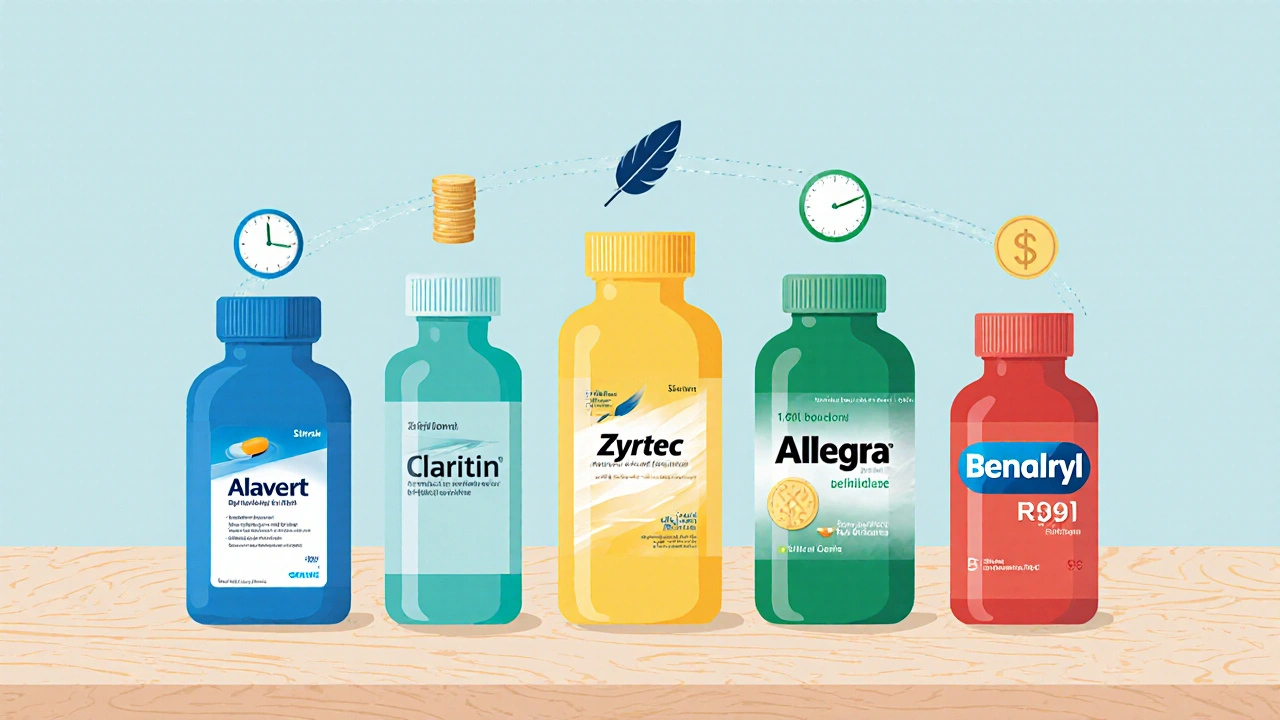
Below are the most widely used antihistamines that people compare to Alavert. Each belongs to the same drug class - H1‑receptor blockers - but they differ in potency, drowsiness risk, and price.
- Claritin - another brand of loratadine, essentially the same formulation but marketed mainly in the US.
- Zyrtec - contains Cetirizine, a second‑generation antihistamine that works a bit faster.
- Allegra - contains Fexofenadine, known for a very low sedation profile.
- Benadryl - contains Diphenhydramine, a first‑generation antihistamine that causes marked drowsiness.
Side‑effect snapshot
Understanding how each drug makes you feel is critical, especially if you need to stay alert at work or school.
| Brand | Active ingredient | Typical drowsiness level | Other common side‑effects |
|---|---|---|---|
| Alavert | Loratadine | Low | Headache, dry mouth |
| Claritin | Loratadine | Low | Similar to Alavert |
| Zyrtec | Cetirizine | Low‑moderate (about 10% report mild sleepiness) | Fatigue, dry mouth |
| Allegra | Fexofenadine | Very low | Headache, nausea |
| Benadryl | Diphenhydramine | High (most users feel sleepy) | Dry mouth, urinary retention, blurred vision |
Cost comparison (UK 2025)
Price can be a deal‑breaker, especially if you need a month‑long supply.
- Loratadine (generic) - £2‑£3 per 30‑tablet pack.
- Cetirizine (generic) - £2‑£4 per 30‑tablet pack.
- Fexofenadine (generic) - £3‑£5 per 30‑tablet pack.
- Diphenhydramine (generic) - £1‑£2 per 30‑tablet pack, but higher indirect cost due to drowsiness‑related productivity loss.
When to pick Alavert over the others
Alavert shines in a few specific scenarios:
- All‑day coverage without sedation. If you need steady relief for school, work, or driving, its 24‑hour non‑drowsy profile is hard to beat.
- Seasonal allergies with mild symptoms. The side‑effect load is light, so you won’t feel foggy.
- Budget‑conscious shoppers. Generic loratadine matches Alavert’s effectiveness at a lower price.

Best alternatives for specific needs
Not every allergy situation fits the same mold. Here’s a quick guide on which alternative might be a better fit.
- Faster onset (under an hour). Zyrtec often starts working in 30‑60minutes, useful for sudden outbreaks.
- Zero sedation for night‑shifts. Allegra has the lowest reported drowsiness, making it ideal for people who must stay alert at odd hours.
- Cost‑cutting when drowsiness isn’t a problem. Benadryl is cheap and effective for short‑term relief, such as an occasional outdoor event.
- Prescription‑strength relief. If OTC options fail, doctors may prescribe a stronger antihistamine or a nasal steroid spray - not covered here but worth a chat with your GP.
Quick decision checklist
Use this short list to settle on the right product in a minute:
- Do you need non‑drowsy relief? → Choose Alavert, Claritin, or Allegra.
- Is fast onset more important than cost? → Choose Zyrtec.
- Is price the biggest factor and you can tolerate sleepiness? → Choose Benadryl.
- Do you have a specific medical condition (e.g., asthma, chronic urticaria) that requires a prescription? → Consult your GP.
Frequently Asked Questions
Can I take Alavert with other allergy medicines?
Generally, you should avoid stacking two H1‑antihistamines because you won’t get extra relief and may increase side‑effects. If you need extra help, talk to a pharmacist about adding a nasal spray or eye drops instead.
Is Alavert safe for children?
Loratadine is approved for children 2years and older at a reduced dose (5mg). Alavert’s 10mg tablet is meant for adults, so check the label for the pediatric formulation or use a liquid generic version.
Will Alavert interact with alcohol?
Loratadine has a low interaction risk, but drinking large amounts of alcohol can increase drowsiness for any antihistamine. Moderation is advised.
How long can I use Alavert daily?
Most guidelines say it’s safe for continuous use up to six months. If symptoms persist longer, see a doctor to rule out underlying conditions.
Is there a generic version of Alavert in the UK?
Yes - loratadine tablets sold by major pharmacy chains are the same active ingredient and cost less than the brand name.
Jessica Martins
October 12, 2025 AT 16:15I’ve been using loratadine for years, and it’s rarely caused any drowsiness. The price point you mentioned matches what I see at my local pharmacy. For mild seasonal allergies it works reliably.
Doug Farley
October 12, 2025 AT 16:40Wow, another groundbreaking comparison of antihistamines that nobody needed. The claim that Alavert is ‘non‑drowsy’ is as original as saying water is wet. If you want a truly scientific take, you should have cited the half‑life data and the CYP450 interactions.
Jeremy Olson
October 12, 2025 AT 17:05I understand that many patients feel overwhelmed by the sheer number of OTC options. Your breakdown helps clarify which formulation aligns with different daily demands. It’s especially useful for those who need steady coverage without compromising alertness.
Ada Lusardi
October 12, 2025 AT 17:30Totally get the struggle of choosing a pill when you have a busy schedule 😊. Alavert does the job without making you feel like a zombie, which is a small win.
Pam Mickelson
October 12, 2025 AT 17:55Great rundown, thanks for the clear guide!
April Rios
October 12, 2025 AT 18:20When we trace the lineage of modern antihistamines, we encounter a tapestry woven from both chemistry and human experience.
Alavert, as a brand of loratadine, represents the triumph of second‑generation design, where the goal was to silence histamine without silencing consciousness.
This is not merely a pharmacological footnote; it is a reflection of our collective desire to remain functional amid the pollen onslaught.
Yet the market teems with alternatives, each promising a slightly different shade of relief.
Zyrtec, with its cetirizine core, advertises a faster onset, a feature that appeals to the impatient ethos of contemporary life.
Allegra’s fexofenadine, on the other hand, trades speed for an almost negligible sedation profile, catering to night‑shift workers and students pulling all‑nighters.
Benadryl, the venerable first‑generation stalwart, accepts drowsiness as a trade‑off for potent, immediate control, a choice that harkens back to a time when waking up to a thriving garden of flowers was a luxury.
The economic dimension cannot be ignored; a thirty‑tablet pack of generic loratadine often costs less than a cup of artisanal coffee, while fexofenadine hovers a few pennies higher.
These price differentials, however, are but a surface layer over the deeper question of individual variability.
Genetic polymorphisms in CYP450 enzymes can render one person exquisitely sensitive to cetirizine’s mild sedation, while another breezes through it unnoticed.
Thus, the “best” antihistamine is not a universal constant but a personalized equilibrium between efficacy, side‑effects, and lifestyle constraints.
From a clinical standpoint, continuous use beyond six months should prompt a conversation with a healthcare professional, as chronic inflammation may signal underlying pathology.
In practice, many find that rotating between loratadine and cetirizine every few months mitigates tolerance buildup, a strategy worth discussing with a pharmacist.
Ultimately, the decision matrix you presented-non‑drowsy, fast onset, price, and prescription‑strength needs-mirrors the real‑world calculus each of us performs daily.
May your readers navigate this maze with confidence, armed with both data and self‑knowledge.
Julie Sook-Man Chan
October 12, 2025 AT 18:45I appreciate the depth of the philosophical view; it nicely ties the science back to personal experience.
Amanda Mooney
October 12, 2025 AT 19:10Thank you for compiling such a thorough comparison, it will certainly aid many who are navigating the OTC landscape.
nalina Rajkumar
October 12, 2025 AT 19:35Super helpful thanks 😊 glad to see the inclusive tone
Michael Barrett
October 12, 2025 AT 20:00Let us observe; the pharmacodynamics of antihistamines-particularly the second‑generation agents-are delineated by receptor affinity, half‑life, and central nervous system penetration!!!; moreover, the economic implications, as you noted, intertwine with accessibility; thus, a holistic appraisal demands both biochemical insight and socioeconomic awareness!!!
Inma Sims
October 12, 2025 AT 20:25While the enthusiasm is commendable, one must remember that excessive punctuation does not substitute for nuanced analysis.
Gavin Potenza
October 12, 2025 AT 20:50All in all, the conversation reflects how everyday choices about a tiny tablet can spark big thoughts about health, economics, and personal freedom.