Glaucoma Medication Risk Checker
Medication Safety Assessment
Results
- Sudden blurry vision
- Severe eye pain
- Headache around the eye
- Halos around lights
- Nausea or vomiting with eye pain
Many people reach for antihistamines when their nose is runny or their eyes are itchy from pollen. But if you have glaucoma-especially a type called narrow-angle glaucoma-those same pills could trigger a medical emergency. You might not even know you’re at risk. That’s the scary part.
What’s the real danger?
Not all glaucoma is the same. About 70% of people with glaucoma have primary open-angle glaucoma (POAG). For them, most over-the-counter allergy meds are generally safe. But the other 10% to 15% have narrow-angle glaucoma. This means the space between the iris and cornea in their eye is too tight. When that space closes, fluid can’t drain out of the eye. Pressure builds up fast. And that’s when vision can blur, turn cloudy, or vanish entirely-in hours. Antihistamines like diphenhydramine (Benadryl) and chlorpheniramine cause your pupils to dilate. That might sound harmless. But in someone with narrow angles, dilated pupils can physically block the drainage channel. It’s like closing a door on a sink’s drain. Fluid backs up. Pressure spikes. Acute angle-closure glaucoma follows. This isn’t a slow, silent disease. It’s sudden. Painful. And it can blind you permanently if not treated immediately.Which allergy meds are risky?
First-generation antihistamines are the main culprits. These are the ones that make you drowsy. They’re in many cold, flu, and allergy combos:- Diphenhydramine (Benadryl, NyQuil, ZzzQuil)
- Chlorpheniramine (Chlor-Trimeton)
- Hydroxyzine (Atarax)
- Doxylamine (Unisom)
It’s not just antihistamines
Other common meds can do the same damage:- Decongestants like pseudoephedrine (Sudafed) and phenylephrine-found in cold remedies-can raise eye pressure too.
- Steroid nasal sprays or eye drops used for more than 10 days can cause open-angle glaucoma by clogging drainage tissue with protein buildup.
- Antidepressants like SSRIs (Prozac, Zoloft) and SNRIs (Effexor) have been linked to acute angle-closure in studies, especially at higher doses.
- Anti-nausea pills like Phenergan and Meclizine also dilate pupils.
- Migraine drugs like topiramate (Topamax) and sumatriptan can swell eye structures and trigger closure.
- Sulfa-based antibiotics like sulfamethoxazole can cause fluid buildup behind the iris.
Who’s most at risk?
You’re more likely to have narrow-angle glaucoma if you’re:- Over 40
- Female
- Asian or Inuit descent
- Farsighted (hyperopic)
- Have a family history of glaucoma
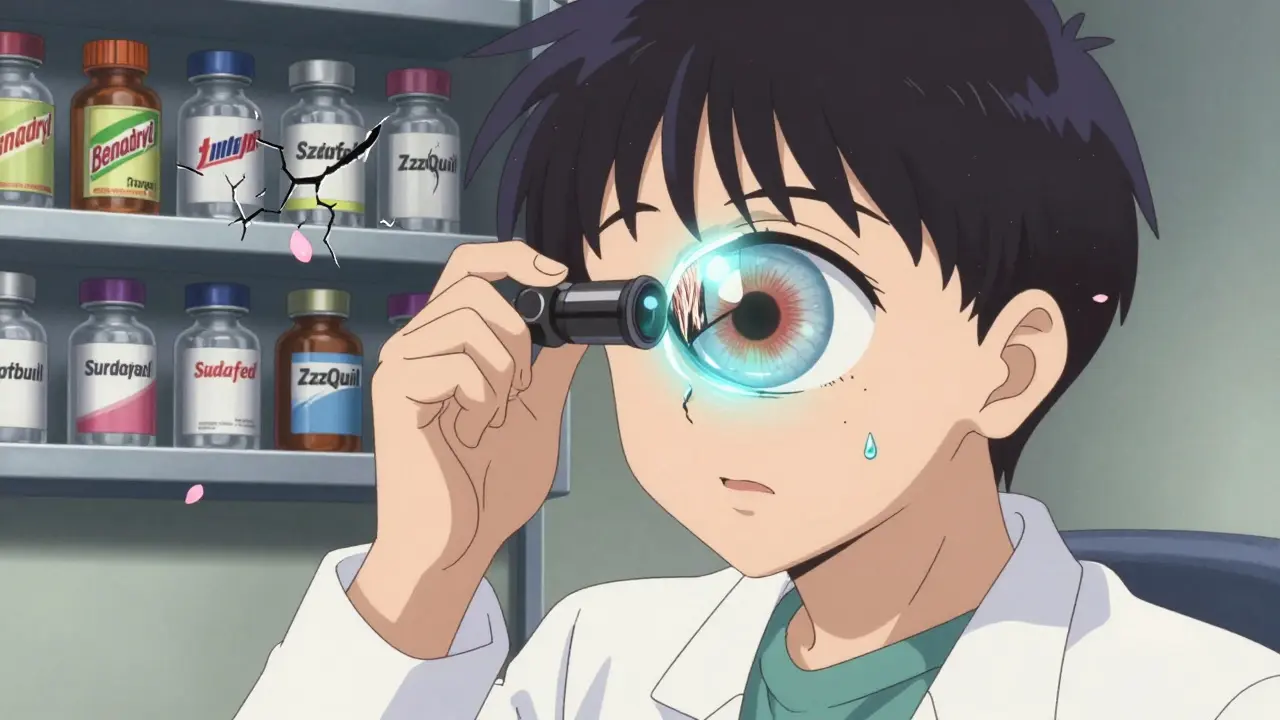
What if you’ve already taken one of these meds?
If you have glaucoma and accidentally took Benadryl or Sudafed, don’t panic. But watch for warning signs:- Sudden blurry vision
- Severe eye pain
- Headache around the eye
- Halos around lights
- Nausea or vomiting with eye pain
What can you do instead?
If you have narrow-angle glaucoma, you still need relief from allergies. Here’s what works:- Second-gen antihistamines: Claritin, Zyrtec, Allegra-these are your best bet.
- Nasal corticosteroid sprays: Flonase, Nasacort. Use them as directed. Don’t go past 10 days without checking eye pressure.
- Saline nasal rinses: Neti pots or sprays help clear allergens without drugs.
- Allergy eye drops: Olopatadine (Patanol) or ketotifen (Zaditor)-these are safe and targeted.
- Environmental controls: Air purifiers, HEPA filters, washing bedding weekly, staying indoors on high-pollen days.
What about laser treatment?
If you’ve been diagnosed with narrow angles, your doctor might suggest a laser iridotomy. This tiny hole in the iris lets fluid flow freely, preventing angle closure. Once you’ve had it, your risk drops significantly. Many people can then use antihistamines safely. But even then-don’t assume. Always check with your eye specialist before starting any new medication.
Why isn’t this better labeled?
You won’t see "Warning: May cause blindness in glaucoma patients" on the side of a Benadryl bottle. The FDA doesn’t require it. Most OTC labels just say "consult your doctor if you have glaucoma." That’s not enough. Glaucoma UK and other advocacy groups have been pushing for clearer warnings since 2022. Right now, the system relies on you knowing your own diagnosis-and most people don’t.What should you do right now?
If you’ve been diagnosed with glaucoma:- Find out what type you have. Ask your doctor: "Do I have open-angle or narrow-angle glaucoma?"
- Get a list of all your meds-prescription, OTC, supplements-and bring it to your eye appointment.
- Ask: "Which of these are safe for me?"
- Wear a medical ID bracelet that says "Narrow-Angle Glaucoma" if you’re at risk.
- Keep a list of safe alternatives handy-so you’re not scrambling when allergy season hits.
- Get a comprehensive eye exam-including gonioscopy.
- Don’t wait for symptoms. Glaucoma doesn’t warn you.
- Ask your optometrist to check your drainage angle.
There’s hope
Research is moving forward. A 2023 clinical trial is testing a modified version of loratadine that’s less likely to affect the eye. Studies also suggest statins-common cholesterol meds-might slow open-angle glaucoma progression. Better screening, better labeling, and better awareness are coming. But for now, the safest thing you can do is know your eyes.Don’t let a simple allergy pill cost you your sight. A quick conversation with your eye doctor could change everything.
Can I take Zyrtec if I have glaucoma?
Yes, cetirizine (Zyrtec) is generally safe for people with glaucoma. It’s a second-generation antihistamine with very little effect on pupil size or eye pressure. But always confirm with your eye doctor, especially if you have narrow-angle glaucoma or have never had your drainage angle checked.
Is Benadryl dangerous for glaucoma patients?
Yes. Diphenhydramine (Benadryl) can trigger acute angle-closure glaucoma in people with narrow angles. It causes pupil dilation, which can block fluid drainage and spike eye pressure rapidly. Avoid it completely if you have narrow-angle glaucoma or haven’t been tested.
Can steroid nasal sprays cause glaucoma?
Yes. Long-term use of steroid nasal sprays (more than 10 days) can raise eye pressure in anyone, even those without glaucoma. This can lead to open-angle glaucoma over time. If you use them regularly, get your eye pressure checked every 3-6 months.
Do I need to avoid all allergy meds if I have glaucoma?
No. Only certain types are risky. First-gen antihistamines and decongestants are dangerous for narrow-angle glaucoma. Second-gen antihistamines like Claritin and Allegra are usually safe. Nasal sprays and eye drops designed for allergies can also be used safely with monitoring. Always get your glaucoma type confirmed first.
What should I do if I suddenly lose vision after taking an allergy med?
Seek emergency care immediately. Sudden vision loss, eye pain, nausea, or seeing halos around lights after taking an antihistamine or decongestant could mean acute angle-closure glaucoma. This is a sight-threatening emergency. Go to the ER or call your eye doctor right away-don’t wait.
swarnima singh
January 16, 2026 AT 21:20i just took benadryl last week for my allergies and now my eyes feel weird… like someone poured glue in them. i didn’t think it had anything to do with my glaucoma bc i never got tested. now i’m scared to even blink. why do they even sell this stuff if it can blind you??
Isabella Reid
January 17, 2026 AT 23:25This is such an important post. I’m a nurse in Oregon and I’ve seen too many patients come in with sudden vision loss after taking OTC meds. The worst part? They had no idea they had narrow-angle glaucoma. Doctors should be required to screen everyone over 40 during routine visits. It’s not just about allergies-it’s about systemic ignorance.
And yes, Zyrtec is safe. But people don’t read labels. They grab what’s cheapest or what their grandma used. We need better labeling, not just ‘consult your doctor.’ That’s lazy.
kanchan tiwari
January 18, 2026 AT 01:35THEY KNOW. THEY KNOW AND THEY DON’T CARE.
Big Pharma doesn’t want you to know that your allergy pill could blind you. That’s why there’s no warning on the bottle. Why do you think the FDA doesn’t require it? Because if people stopped buying Benadryl, their profits would CRASH.
And don’t even get me started on how they use ‘consult your doctor’ as a loophole. Who has time for that? Who even knows their eye type? This is a cover-up. I’ve seen the documents. They’ve known since the 90s.
Someone’s gonna die because of this. And then they’ll say ‘oh, we didn’t realize.’ LIES. EVERYTHING IS A LIE.
evelyn wellding
January 19, 2026 AT 12:01OMG thank you for posting this!! 😭 I’ve been using Benadryl for years and just assumed it was fine. I’m 42, farsighted, and my mom has glaucoma… I’m booking an eye exam tomorrow!!
Zyrtec it is from now on!! 🙌 Also, anyone else use saline rinses? They’re a game-changer for me-no drugs, just water and salt. So simple.
Stay safe, friends!! 💙
Bianca Leonhardt
January 20, 2026 AT 09:22People like you who just ‘assume’ everything’s fine are why this problem persists. You don’t get a free pass because you’re ‘allergic.’ If you’re over 40 and haven’t had gonioscopy, you’re not just negligent-you’re dangerous to yourself and everyone around you who might inherit your eye structure.
And no, ‘natural remedies’ aren’t magic. Quercetin won’t save you. Your eyes don’t care about your Instagram wellness aesthetic. Get tested. Stop being lazy.
Travis Craw
January 21, 2026 AT 14:32man i didn’t even know glaucoma had different types. i thought it was just ‘high pressure in the eye.’
my mom had it and she never told me what kind. now i’m kinda scared to take anything for allergies. i’ll ask my doc next time. thanks for laying it out like this.
vivek kumar
January 22, 2026 AT 21:26Let me clarify the science here: first-generation antihistamines are muscarinic receptor antagonists, which inhibit parasympathetic activity in the iris sphincter muscle, leading to unopposed sympathetic-mediated mydriasis. In anatomically narrow angles, this dilation mechanically obstructs the trabecular meshwork.
Second-generation agents like cetirizine and loratadine have minimal CNS penetration and negligible anticholinergic effects-hence their safety profile. This is not anecdotal; it’s pharmacokinetics.
Also, steroid-induced glaucoma is dose- and duration-dependent. Ten days is a reasonable threshold based on multiple longitudinal studies.
And yes-laser iridotomy is the gold standard prophylaxis. It’s outpatient, takes 5 minutes, and reduces acute closure risk by over 90%. If your doctor hasn’t offered it, ask why.
Nick Cole
January 24, 2026 AT 01:00Just wanted to say thank you. I’ve had narrow-angle glaucoma for 10 years and never knew what meds to avoid. I used to take Sudafed for sinus stuff. Now I know why I had that one terrifying episode in 2020.
This post saved me from another mistake. I’m printing it out and giving it to my family. You’re right-it’s not just about allergies. It’s about everything you put in your body.
Thank you for being the voice that wasn’t there before.