
When you stand up from a chair, your body does something automatic: it tightens blood vessels and speeds up your heart just enough to keep blood flowing to your brain. But if you have autonomic neuropathy, that system breaks down. You don’t just feel lightheaded-you might collapse. Or you might sit down to eat and end up vomiting hours later, even though your stomach feels full but won’t empty. This isn’t just "bad luck" or "getting older." It’s nerve damage, and it’s more common than most people realize.
What Exactly Is Autonomic Neuropathy?
Autonomic neuropathy isn’t a single disease. It’s damage to the nerves that control your body’s invisible functions-things you don’t think about, like heart rate, digestion, sweat, and blood pressure. These nerves are part of the autonomic nervous system, and when they get damaged, your body loses its ability to adjust automatically to what’s happening around you.
Most cases-about 85 to 90%-are tied to diabetes. Long-term high blood sugar slowly poisons these tiny nerves. But it’s not just diabetes. Chemotherapy, autoimmune diseases, Parkinson’s, and even some viral infections can trigger it. The damage builds up quietly. Many people don’t notice symptoms until they’ve had diabetes for over 10 years. By then, the nerves are already struggling.
Why Your Blood Pressure Plummets When You Stand Up
Stand up too fast, and you might feel dizzy, see spots, or even pass out. That’s orthostatic hypotension. In healthy people, your body reacts within seconds: blood vessels squeeze tighter, your heart beats faster, and your blood pressure stays steady. In autonomic neuropathy, that reaction fails.
Doctors define it as a drop of at least 20 mmHg in systolic pressure (the top number) or 10 mmHg in diastolic (the bottom number) within three minutes of standing. In severe cases, the drop can be 35 mmHg or more. One study of 450 patients found that 68% had blood pressure below 90 mmHg when standing. That’s dangerously low.
Some people don’t just drop pressure-they spike their heart rate instead. That’s POTS (Postural Orthostatic Tachycardia Syndrome). Your heart races to 120 bpm or more within 10 minutes of standing, even though your blood pressure doesn’t fall. It’s exhausting. You feel like you’ve run a marathon just to walk to the kitchen.
And it’s not just standing. Even sitting or lying down can trigger problems. Some patients experience sudden drops in blood pressure during meals or after warm showers. The body just can’t regulate anymore.
What’s Going On in Your Gut?
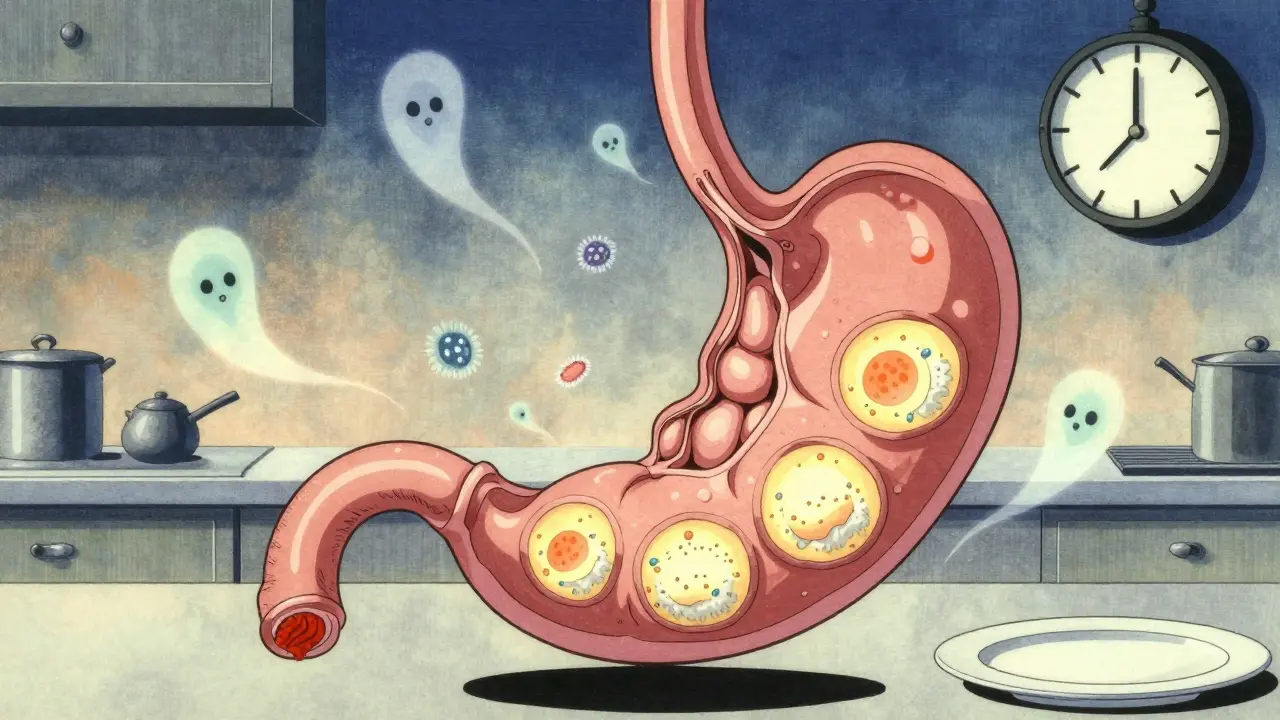
If your stomach won’t empty, food sits there. Not just for an hour-sometimes for hours. That’s gastroparesis, one of the most common GI symptoms in autonomic neuropathy. About 30% of diabetic patients with nerve damage develop it. You eat, but your stomach doesn’t move. The result? Nausea, bloating, early fullness, and vomiting-often at night.
One study found that 78% of gastroparesis patients with autonomic neuropathy vomited at night. Nearly half had it every day. It’s not laziness. It’s not "just stress." It’s a paralyzed stomach muscle.
But it doesn’t stop at the stomach. The whole digestive tract gets confused. Constipation affects 60% of patients. Bowel movements drop from 4-5 times a week to just 1 or 2. Meanwhile, 25% have diarrhea-often sudden, watery, and happening at night. Some people alternate between constipation and diarrhea, which makes it even harder to manage.
And here’s the hidden problem: small intestinal bacterial overgrowth, or SIBO. When food sits too long in the gut, bacteria multiply. In autonomic neuropathy, 52% of those with GI symptoms test positive for SIBO-compared to just 15% in healthy people. That’s why bloating, gas, and diarrhea stick around even when you change your diet.
How Doctors Diagnose It
Most doctors don’t test for autonomic neuropathy unless you’re clearly struggling. That’s a problem. A 2021 audit found that primary care doctors only recognized symptoms in 30% of cases. Many patients see three or more specialists before getting a diagnosis-sometimes after waiting nearly five years.
There are tests. The simplest is the 10-minute active stand test: you lie down, then stand up while your blood pressure and heart rate are monitored. A drop of 20/10 mmHg confirms orthostatic hypotension. A heart rate increase over 30 bpm points to POTS.
For digestion, the gold standard is gastric emptying scintigraphy. You eat a meal with a harmless radioactive tracer, then an imaging scan tracks how fast it leaves your stomach. If more than 10% is still there after 4 hours, you have gastroparesis. Newer tests like the wireless motility capsule are just as accurate and less invasive.
There’s also the COMPASS-31 questionnaire, which scores symptoms like dizziness, GI issues, and sweating problems on a scale from 0 to 100. A score over 30 means significant autonomic dysfunction. It’s not perfect, but it’s reliable-and it’s used in clinics now to catch problems early.
Treatment: What Actually Works
There’s no cure. But there are ways to manage symptoms-sometimes dramatically.
For blood pressure drops, compression stockings (30-40 mmHg) help 35% of patients. So do abdominal compression garments, which one 2022 Mayo Clinic trial showed reduced orthostatic symptoms by 40%. Drinking more water and adding salt to your diet (under medical supervision) can also help your body hold onto fluid.
Medications? Fludrocortisone increases blood volume, but 35% of users end up with high blood pressure when lying down. Midodrine works for 70% of people, but you have to time your doses carefully-no dose after 6 PM or you’ll sleep with dangerously high pressure. Ivabradine, originally for heart conditions, reduces heart rate in POTS by 15-25 bpm in 65% of patients. It’s not perfect, but for many, it’s life-changing.
For gastroparesis, metoclopramide was once the go-to. But it carries a black box warning: long-term use can cause irreversible movement disorders. Erythromycin helps short-term, but tolerance builds fast. The newer option? Pyridostigmine. It improves symptoms in 55% of patients with minimal side effects. It’s not flashy, but it’s safer.
And diet? Huge. Eating six small meals a day, cutting fat under 25 grams, and fiber under 10 grams can cut vomiting episodes in half. One patient on Reddit said it reduced her daily vomiting from five times a day to once every three days. That’s not a miracle-it’s science.

The Hidden Cost: Life Beyond Symptoms
Autonomic neuropathy doesn’t just mess with your body. It wrecks your life.
People describe "brain fog" during blood pressure drops. They can’t think clearly. They cancel plans. They avoid restaurants because they don’t know if they’ll vomit. One survey found 62% of patients had to change their social life because of GI symptoms. Another 76% wear compression gear daily. Eighty-nine percent avoid hot environments-showers, saunas, even summer days.
Work becomes impossible for many. One expert noted that 78% of severe cases report being unable to work. You can’t stand for long. You can’t travel. You can’t predict when you’ll feel sick.
And the diagnosis delay? It’s cruel. Waiting years for answers means you’re already living with complications-low blood pressure, malnutrition, repeated hospital visits-before you even get treatment.
What’s Changing Now?
Things are starting to shift. In 2024, the American Diabetes Association will recommend annual autonomic screening for anyone with diabetes longer than 7 years. That could catch half a million new cases each year.
New blood tests are on the horizon. Researchers found that levels of a protein called neurofilament light chain in the blood correlate strongly with nerve damage severity. A simple blood draw might one day replace long, uncomfortable tests.
And the diagnostic bar is lowering. The 2025 American College of Cardiology guidelines will now define orthostatic hypotension at a drop of just 15 mmHg-instead of 20. That means earlier intervention. More people will get help before they collapse.
For now, the best advice is simple: if you have diabetes and feel dizzy when standing, or if you’re vomiting without a clear cause, ask your doctor about autonomic neuropathy. Don’t wait. Don’t assume it’s "just aging." Your body is trying to tell you something.
Christina VanOsdol
February 25, 2026 AT 22:02Okay but like… I’ve been standing up and seeing spots for 8 years and no one ever said "autonomic neuropathy" until I screamed about it in the ER. Now I wear compression socks like they’re leggings. And yes, I still vomit after dinner. But at least I know why. 😭
Alfred Noble
February 27, 2026 AT 09:51Been there. Diabetic for 12 years. Started with dizziness, then bloating, then midnight vomiting. Docs thought I was just "eating wrong." Took 4 years to get diagnosed. Midodrine saved me. But man… the fatigue? Still rough. 💪
Matthew Brooker
February 28, 2026 AT 02:53If you’re reading this and you’ve got diabetes-don’t wait. If standing up makes you dizzy, ask for the active stand test. It’s simple. It’s free. It could change your life. You’re not overreacting. Your body’s screaming. Listen.
And yeah, I’m not a doctor. But I’ve been helping people with this for 15 years. You’re not alone.
Emily Wolff
March 1, 2026 AT 03:00Typical. Another post pretending this is "underdiagnosed." It’s not. It’s just people refusing to control their sugar. Stop blaming nerves. Blame the donuts.
Joseph Cantu
March 1, 2026 AT 19:32They don’t want you to know this… but the real cause is 5G towers + CDC cover-ups. They pump toxins into the water supply to keep people docile. I know a guy who got his blood tested-neurofilament levels were off by 700%. That’s not science. That’s control. And don’t get me started on the salt recommendation. Salt is poison. 🕵️♂️
Jacob Carthy
March 2, 2026 AT 13:34Why are we even talking about this? Just drink more water. Eat less carbs. Work harder. America doesn’t have time for weak nerves. We built this country on grit. You can’t just sit down and wait for medicine to fix you. Get up. Move. Stop whining.
Lisandra Lautert
March 4, 2026 AT 12:27"Vomiting at night." That’s not a symptom. That’s a lifestyle choice.
Cory L
March 6, 2026 AT 07:09Just wanted to say-you’re not broken. You’re not lazy. You’re not failing. You’re a warrior. Every time you stand up, even when you shake, even when you see stars-you’re winning.
And if you’re reading this right now? You’re already halfway there. Keep going. I believe in you. 💙
Bhaskar Anand
March 7, 2026 AT 06:06In India, we don’t have this problem. We eat spicy food, walk 10km daily, and never sit down. Why are Americans so weak? Your blood pressure drops because you sit on couches all day. Fix your lifestyle. Not your nerves.
William James
March 8, 2026 AT 19:49It’s funny… we treat nerve damage like it’s a failure. But what if it’s not? What if it’s just your body trying to tell you: slow down. Reconnect. Listen.
Maybe the real cure isn’t medication-it’s presence. Not fixing the system… but learning to live inside it. I’ve seen people heal just by sitting quietly with their pain. Not fighting it. Just… being with it.
It’s not magic. It’s mindfulness. And it’s real.
David McKie
March 9, 2026 AT 23:40They call it autonomic neuropathy. I call it the quiet genocide of chronic illness. No one talks about it. No one funds it. You’re left to Google symptoms at 3 a.m. while your stomach churns and your heart races. And then? They hand you a pamphlet and say "drink water."
It’s not medical negligence. It’s systemic abandonment. And we’re all complicit.
Southern Indiana Paleontology Institute
March 10, 2026 AT 08:09My cousin had this. She went to 7 doctors. One said it was ghosts. Another said it was the flu. Then she got a blood test and it was confirmed. Now she’s on meds. She’s okay. But I still don’t trust hospitals. They lie. They lie a lot.
Anil bhardwaj
March 11, 2026 AT 15:57I have diabetes. I feel dizzy sometimes. But I don’t think it’s serious. I just take a nap. It goes away. Maybe this is overblown?