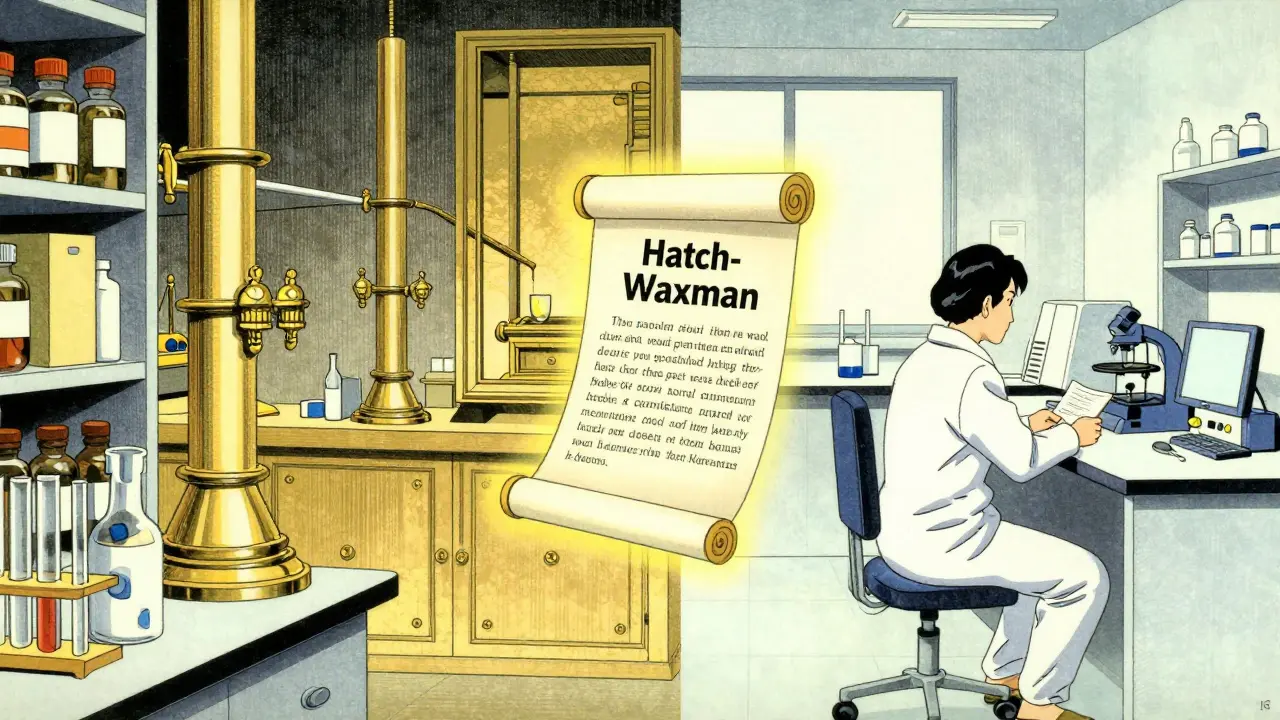
Imagine spending $2.6 billion and a decade of your life developing a new medicine, only to have another company launch a nearly identical version a few years later for a fraction of the cost. That is the core of the U.S. drug market. But how does the government ensure that a cheap generic isn't just "sugar water"? That is where the FDA regulatory authority is the federal oversight power used to ensure generic drugs are safe, effective, and chemically identical in performance to their brand-name counterparts comes into play. For most of us, this means the difference between a $390 monthly insulin bill and a $98 one, but for manufacturers, it is a high-stakes regulatory gauntlet.
The Shortcut to Pharmacy Shelves: Understanding the ANDA
You don't need to reinvent the wheel to launch a generic drug. Under the Hatch-Waxman Act of 1984, the FDA created a streamlined path called the Abbreviated New Drug Application (or ANDA). Unlike a full New Drug Application (NDA), which requires massive clinical trials to prove a drug actually works, an ANDA allows a company to skip those steps. Why? Because the FDA already knows the drug works-the brand-name company already proved it.
The "abbreviated" part of the ANDA process means the manufacturer only has to prove therapeutic equivalence. This is a fancy way of saying the generic does the exact same thing as the brand name. To get the green light, the drug must have the same active ingredient, strength, dosage form, and route of administration. If the brand name is a 10mg tablet taken by mouth, the generic must be a 10mg tablet taken by mouth. Period.
Proving it Works: The Science of Bioequivalence
The biggest hurdle for any generic is proving bioequivalence. The FDA doesn't just take a company's word for it; they require pharmacokinetic studies. Usually, this involves 24 to 36 healthy volunteers who take both the brand and the generic. Scientists then measure the rate and extent of drug absorption in the blood.
There is a very specific math problem the FDA uses here. The ratio of the geometric means for the drug's absorption (specifically the AUC and Cmax parameters) must fall within a 90% confidence interval of 80.00% to 125.00%. If the drug hits the bloodstream too fast or too slow, the FDA will reject it. This rigor is why 9 out of 10 prescriptions filled in the U.S. are generics-the system is designed to be nearly foolproof.
| Feature | New Drug Application (NDA) | Abbreviated NDA (ANDA) |
|---|---|---|
| Clinical Trials | Full Phase I, II, and III required | Not required (waived) |
| Development Cost | Approx. $2.6 billion | $2.4 to $6.3 million |
| Time to Market | 10-15 years | 3-4 years |
| Primary Goal | Prove safety and efficacy | Prove bioequivalence to RLD |
The Review Gauntlet: From Filing to Approval
Submitting an ANDA isn't as simple as uploading a PDF. These applications are behemoths, often ranging from 15,000 to 20,000 pages. The process starts at the Office of Generic Drugs (OGD). First, the Division of Filing Review checks if the application is even complete. If it's missing key data, the company gets a "Refuse-to-Receive" (RTR) letter. In 2022, about 15.3% of submissions were kicked back this way, mostly due to sloppy chemistry or manufacturing sections.
Once filed, the drug enters a substantive review. Standard applications usually have a Target Action Date (TAD) of 10 months. However, the FDA fast-tracks priority reviews (down to 8 months) for drugs that are in short supply or are the first generic version of a drug to hit the market. This urgency is critical because every day a brand-name monopoly lasts, patient costs remain high.
Beyond the paperwork, the FDA inspects the factories. Every plant must follow Current Good Manufacturing Practice (CGMP) regulations. If a facility is dirty or the equipment is outdated, the drug won't be approved, regardless of how well the bioequivalence tests went. On average, about 82.7% of generic facilities are inspected annually to keep these standards tight.
The Challenge of Complex Generics
Not all generics are created equal. Making a simple tablet is one thing, but what about an inhaler, a topical cream, or an extended-release capsule? These are known as "complex generics." They don't absorb into the body in a straightforward way, making bioequivalence much harder to prove.
The FDA has recognized this difficulty and launched the Complex Generic Drugs Initiative. It's working. In 2018, only 22.1% of approvals were complex products; by 2023, that number jumped to 37.5%. The agency is even piloting AI-assisted reviews and integrating real-world evidence to speed up these specific approvals, targeting 25% of complex approvals to use this data by 2026.
The Bottom Line: Cost, Competition, and Access
Why does the FDA put so much effort into this? The economic impact is staggering. Generics make up 90% of the volume of prescriptions in the U.S. but only 23% of the spending. This creates an estimated $132.6 billion in annual savings for the healthcare system. When a generic enters the market, prices often plummet by 80% to 85%.
However, the system isn't perfect. There are often massive backlogs. For example, a 2022 report showed nearly 1,800 pending ANDAs, with some waiting over three years for a review. There is also the "patent dance," where brand-name companies challenge generics in court to delay their entry. Despite this, the FDA's Drug Competition Action Plan has successfully cut the approval time for first-time generics by over 37% since 2017.
Does the FDA require generics to have the same inactive ingredients?
No. While the active ingredient must be identical, inactive ingredients (fillers, binders, dyes) can differ. This is why some people might have a reaction to a generic drug even if the active medicine is the same as the brand.
What is the "Orange Book"?
The Orange Book is the official FDA publication that lists all approved drug products. It provides the therapeutic equivalence ratings, telling pharmacists and doctors whether a generic is considered a substitute for the reference listed drug.
Why are some generics more expensive than others?
Cost usually depends on how many companies are making the drug. If only one or two companies have an approved ANDA, they can keep prices higher. Once multiple generics enter the market, a price war typically drives the cost down significantly.
How much does it cost a company to apply for an ANDA?
Under the GDUFA III guidelines, the user fee for a single ANDA application is $389,490. Additionally, companies pay annual facility fees that can range from roughly $207,700 to $415,400 depending on the site type.
Can a generic drug be less effective than a brand-name drug?
The FDA's bioequivalence standards are designed to ensure they perform the same. While some patients report perceived differences, FDA investigations into adverse event reports found that over 92% of these cases were actually due to the progression of the patient's disease, not the drug's efficacy.
Next Steps for Manufacturers and Patients
If you are a manufacturer looking to enter the market, the smartest move is early engagement. Over 78% of successfully approved applications in 2022 used pre-ANDA meetings with the FDA to clear up potential hurdles before spending millions on submissions. Using the eSTaR (Electronic Submission Template and Resource Center) is also highly recommended, as it has slashed formatting errors by over 60%.
For patients, the best way to ensure you're getting the right medication is to check the therapeutic equivalence in the Orange Book or ask your pharmacist if the generic is "AB-rated," which means it is pharmacy-substitutable without a new prescription. If you have a known allergy to specific dyes or fillers, always ask for the inactive ingredient list of the generic version to avoid adverse reactions.
Robin Walton
April 12, 2026 AT 11:50It's honestly such a relief to know there's a system in place to keep these prices down for people who really need their meds.
Rakesh Tiwari
April 14, 2026 AT 11:49Oh sure, because a 15,000-page application is exactly how you stop corruption in the pharma industry. Pure brilliance.
Danny Wilks
April 15, 2026 AT 13:37The nuance of the Hatch-Waxman Act is truly fascinating when you consider that the balance between rewarding innovation and ensuring public access is a delicate dance that many countries struggle to choreograph correctly, yet the US has managed to create a high-volume generic market that fundamentally alters the accessibility of life-saving treatment for millions.
emmanuel okafor
April 16, 2026 AT 22:55money is just a tool but health is everything so a cheaper drug is a good thing for the poor people
Doug DeMarco
April 18, 2026 AT 14:00Yo! For anyone wondering about the Orange Book, it's basically the gold standard for checking your meds! Definitely worth a look if you're switching brands! 😊🚀
Ben hogan
April 19, 2026 AT 13:01Imagine actually thinking the FDA is efficient. This whole post is just glazing a bloated bureaucracy that takes three years to review a piece of paper. Pathetic.
Trey Kauffman
April 19, 2026 AT 17:23Wait, the inactive ingredients can be different? That explains so much about my last prescription!
Simon Stockdale
April 20, 2026 AT 02:10USA is the only place that can make a generic drug system that actually works while other countries are just playin around with their healthcare and not even triing to lower costs like we do here with the ANDA process which is way better than anything else out there honestly!!!
Chad Miller
April 21, 2026 AT 20:212.6 billion for a drug is just a scam lol who even believes these numbers anyway
Simon Jenkins
April 23, 2026 AT 12:59The sheer audacity of thinking a simple bioequivalence study is enough! We are talking about the chemistry of life, not baking a cake! This process is practically an insult to the rigors of true pharmacological science and I am absolutely appalled by the simplification!
Kelly DeVries
April 24, 2026 AT 18:48the way these companies do the patent dance is just so messy and honestly kind of hilarious how they try to block the generics just to keep the money flowing
Suchita Jain
April 25, 2026 AT 16:19It is a grave misfortune that some manufacturers fail to maintain the utmost cleanliness in their facilities, thereby risking the health of the populace.
Camille Sebello
April 26, 2026 AT 01:26Check your dyes! Always check your dyes!!
Thabo Leshoro
April 27, 2026 AT 10:28The bioequivalence parameters... AUC and Cmax... are absolutely critical!!! The pharmacokinetics must be spot on!!!