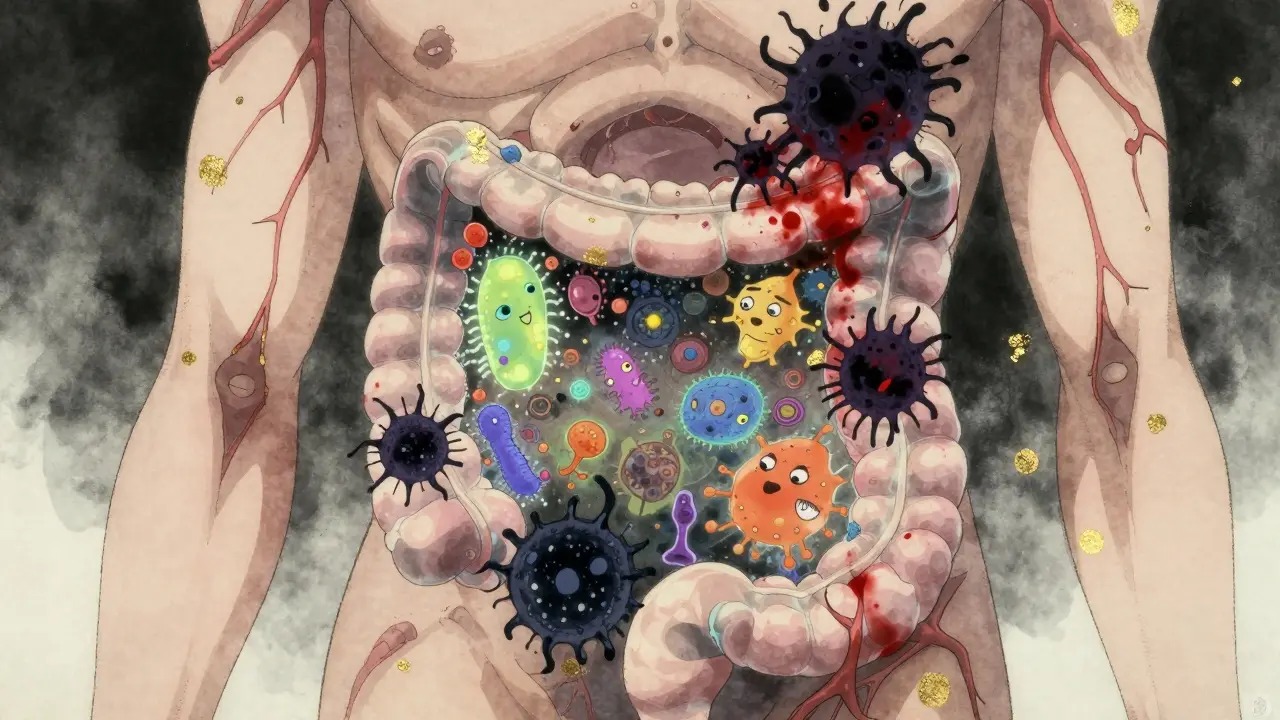
For years, doctors treated autoimmune diseases like rheumatoid arthritis, lupus, and type 1 diabetes as problems inside the immune system-overactive, confused, attacking the body. But now, researchers are looking lower. Way lower. Down into your gut. What’s growing there-trillions of bacteria, viruses, and fungi-might be the real trigger. And it’s not just correlation. By 2025, science has moved past "maybe" to "this is how it works." A 2025 meta-analysis of over 12,000 patients with autoimmune conditions found one consistent pattern: their gut microbes are less diverse. On average, gut microbiome diversity is 23.7% lower than in healthy people. That’s not a small dip. It’s a signal. And it shows up across diseases-rheumatoid arthritis, multiple sclerosis, lupus, type 1 diabetes. Same drop. Same pattern. That suggests something fundamental is going wrong in the gut, and it’s pulling the immune system out of balance.
How Gut Bacteria Start an Autoimmune Fire
Your gut isn’t just a digestive tube. It’s a training ground for your immune system. About 70% of your immune cells live there. They learn what’s harmless food, what’s a threat, and what’s your own body. When this system gets messed up, it starts mistaking your joints, nerves, or pancreas for invaders. One key mechanism? Antigenic mimicry. Some gut bacteria have proteins that look almost identical to your own tissues. When your immune system attacks those bacteria, it accidentally targets your cells too. Think of it like a criminal wearing a mask that looks like your neighbor. The cops (your immune cells) chase the criminal-but end up arresting the neighbor. Then there’s the escape route. In 2025, Yale researchers found that a specific gut bacterium, Enterococcus gallinarum, doesn’t just stay in the intestines. It breaks through the gut lining, travels through the bloodstream, and shows up in the liver, spleen, and lymph nodes-places where immune responses are activated. In lupus patients, this bug was found in extraintestinal tissues in 63% of cases. In healthy people? Only 8%. That’s not a coincidence. That’s a smoking gun.What’s Missing-and What’s Too Much
The gut microbiome isn’t just about bad bugs. It’s also about missing good ones. Across autoimmune diseases, one bacterium keeps disappearing: Faecalibacterium prausnitzii. It’s a major producer of butyrate, a short-chain fatty acid that calms inflammation and tells immune cells to stand down. In patients with RA, MS, and lupus, levels of this bug are down by an average of 41.2%. No butyrate? No brake on inflammation. Meanwhile, another bug, Ruminococcus gnavus, is popping up everywhere. It’s increased by 37.5% in autoimmune patients. This one doesn’t just sit quietly. It triggers inflammatory pathways and may even help autoantibodies stick to your tissues. But here’s the twist: not all bugs act the same in every disease. In type 1 diabetes, the loss of butyrate-producing bacteria is even sharper-32% lower than in rheumatoid arthritis patients. And in multiple sclerosis, researchers found something unique: IgA antibodies binding tightly to specific gut microbes. That means the immune system is actively targeting those bacteria, possibly worsening the problem. Even probiotics aren’t always helpful. One strain, Lactobacillus reuteri, made experimental autoimmune encephalomyelitis (a mouse model of MS) worse by 28%. But other Lactobacillus strains helped. So it’s not "probiotics = good." It’s "the right strain, in the right context, for the right person."From Observation to Intervention
Knowing what’s wrong is one thing. Fixing it is another. But the field is moving fast. There are now over 150 clinical trials registered on ClinicalTrials.gov testing microbiome-targeted therapies for autoimmune diseases. That’s up from just a handful in 2020. The main approaches? Probiotics: 22 specific bacterial strains are being tested. Not your typical yogurt cultures. These are carefully selected, lab-grown strains designed to restore balance-not just add more bugs. Prebiotics: These are food for good bacteria. Galactooligosaccharides (GOS), a type of prebiotic, boosted regulatory T cells-immune cells that suppress autoimmunity-by 34% in a phase II trial for rheumatoid arthritis. Targeted elimination: This is the most exciting. If a bug like Enterococcus gallinarum is triggering lupus, why not kill it? Researchers are testing narrow-spectrum antibiotics or even bacteriophages-viruses that only attack specific bacteria. The goal isn’t to wipe out the whole microbiome. It’s to remove the troublemakers.
What’s Holding Back Real-World Use?
You might be thinking: "Why isn’t this in my doctor’s office yet?" Because it’s still messy. First, testing your gut microbiome isn’t cheap. A full metagenomic sequencing test costs between $1,200 and $3,500 as of late 2025. It takes an average of 78 days to get results back and interpret them. Second, most studies still use different methods. One lab extracts DNA differently than another. One stores samples frozen, another at room temperature. That’s why 68% of studies have inconsistent protocols. You can’t compare apples to oranges if the oranges are being picked by different people in different seasons. Third, most human trials are short. Only 12% track patients for more than six months. Autoimmune diseases don’t flip on and off. They flare and fade over years. We need long-term data. And then there’s the personalization problem. Your microbiome is as unique as your fingerprint. What helps one person might harm another. A therapy that works for a 45-year-old woman with lupus might do nothing-or make things worse-for a 60-year-old man with RA.What’s Coming Next
The money is pouring in. Global funding for microbiome-autoimmunity research hit $847 million in 2024, up 22% from the year before. The NIH launched a $18.7 million initiative in January 2025 to develop three microbiome-modulating therapies by 2028. Companies like Vedanta Biosciences and Seres Therapeutics are racing to bring the first microbiome drugs to market. Vedanta alone has 12 candidates in the pipeline for autoimmune conditions. And adoption is rising. As of October 2024, 38% of academic medical centers now include gut microbiome analysis in lupus care. For rheumatoid arthritis, it’s 22%. For MS, just 15%. But the trend is clear: this isn’t fringe science anymore. Experts agree: by 2030, microbiome profiling will be part of routine autoimmune diagnosis. Not instead of blood tests or imaging-but alongside them. Imagine a doctor saying: "Your antibodies are high, and your gut has low F. prausnitzii and high R. gnavus. Let’s start you on a targeted prebiotic and monitor your microbial shift over the next three months."
What You Can Do Today
You don’t need a $3,000 test to support your gut health. While we wait for precision therapies, here’s what the science says helps:- Eat more fiber-especially from vegetables, legumes, whole grains, and fruits. Fiber feeds good bacteria and boosts butyrate production.
- Reduce ultra-processed foods. They’re linked to gut inflammation and lower microbial diversity.
- Consider fermented foods: yogurt (with live cultures), kefir, sauerkraut, kimchi. They add diversity, not just quantity.
- Avoid unnecessary antibiotics. They don’t just kill bad bugs-they wipe out the good ones too.
- Manage stress. Chronic stress changes gut permeability and alters microbial composition.
Jeremy Hendriks
December 21, 2025 AT 17:27So let me get this straight-we’ve been treating autoimmune diseases like they’re a glitch in the software, when really the problem’s in the fucking hardware? The gut’s the motherboard and we’ve been throwing antivirus patches at it? Wild. I mean, if your immune system’s a toddler trained by a drunk nanny, maybe it’s not the toddler’s fault. Maybe it’s the nanny’s whiskey stash.
Aliyu Sani
December 22, 2025 AT 23:09bro this is deep… like, microbiome ain’t just ‘gut flora’-it’s a whole civilization in there. F. prausnitzii? that’s the chill uncle who keeps the peace. R. gnavus? that’s the cousin who shows up with a boombox and starts a riot. we ain’t fighting our bodies… we fighting the wrong neighbors in the hood.
Gabriella da Silva Mendes
December 24, 2025 AT 04:13Okay but why is this only happening in the US? 😭 Like, I’m not saying Americans are the problem but… we eat garbage, we stress about everything, we take antibiotics for a sniffle, and now our guts are like a Tinder profile full of toxic matches? 🤦♀️ Also, why is this not on the news? I’m not paying $3500 to find out my gut hates me. This is a scam. #AmericanHealthcare
Kiranjit Kaur
December 26, 2025 AT 00:59Love this so much!! 🌱✨ I’ve been eating more lentils and kimchi since last year and my joint pain? Gone. Not 100%, but like… 70% better. I used to think it was ‘just aging’-turns out my gut was throwing a protest. Now I’m like, ‘Hey bacteria, you’re the boss. I’ll feed you.’ 🙏
Jim Brown
December 26, 2025 AT 11:32It is an epistemological revelation of profound magnitude: the immune system, long venerated as the sovereign arbiter of bodily integrity, has been revealed to be a mere instrument, conditioned by an ecological substrate whose complexity dwarfs our capacity for comprehension. The gut microbiome, as a sentient ecosystem, functions not as a passive colony but as a regulatory agent-its metabolic byproducts, its molecular mimicry, its translocation-constitute a symphony of immunomodulation, the dissonance of which precipitates autoimmunity. We are not treating disease; we are attempting to harmonize an orchestra whose conductor we have ignored for decades.
Sai Keerthan Reddy Proddatoori
December 28, 2025 AT 11:05They’re lying. This is all a Big Pharma scam. The real cause? 5G towers. They fry your gut bacteria. And the FDA is in on it. You think they want you to fix your gut? Nah. They want you to buy their drugs forever. They don’t want you healthy. They want you on pills. Also, eat less rice. Rice kills your gut. I read it on a forum.
Johnnie R. Bailey
December 29, 2025 AT 07:05What’s fascinating isn’t just the science-it’s the cultural lag. We’ve got a medical system built on pills and procedures, but the solution? It’s fiber. Fermented food. Sleep. Stress management. The most powerful medicine in human history is… not a patent. It’s a damn carrot. And yet we spend billions on drugs that suppress, not restore. The irony? We’re smarter than our systems. We just haven’t demanded better.
Vikrant Sura
December 29, 2025 AT 10:2923.7% lower diversity? That’s a statistically significant rounding error. Also, correlation ≠ causation. You didn’t control for diet, meds, or socioeconomic status. This whole field is overhyped. Give me a double-blind RCT with 10k subjects and I’ll believe it. Until then, it’s just microbiome woo.
Tarun Sharma
December 29, 2025 AT 23:09Thank you for this comprehensive overview. The evidence is compelling. However, I must emphasize that microbiome analysis should complement, not replace, conventional diagnostics. Clinical judgment remains paramount.
Candy Cotton
December 31, 2025 AT 19:51As an American, I find it offensive that this research is being led by foreign institutions. We invented modern medicine. Why are we letting Indians and Nigerians dictate our gut health? Also, why is this not being funded by the U.S. government? This is a national security issue.
Ajay Brahmandam
January 2, 2026 AT 17:14Man, I’ve been eating oats and sauerkraut every morning since last year. No magic cure, but my bloating? Gone. My brain fog? Less. I didn’t even know I was sick till I started feeling better. Sometimes the fix is just… stop poisoning yourself.
Cara Hritz
January 2, 2026 AT 20:29Wait so if I eat yogurt I can cure lupus? I tried that and my stomach hurt. Maybe I got the wrong kind? Also, I think you meant ‘Fecalibacterium’ but you spelled it wrong. 😅
Jamison Kissh
January 2, 2026 AT 21:08What if the real problem isn’t the bacteria… but the silence? We’ve been trained to see our bodies as machines to be fixed, not ecosystems to be listened to. Maybe the gut isn’t broken-it’s screaming. And we’ve been too busy chasing pills to hear it.