
Every year, millions of workers across the U.S. are exposed to dangerous levels of noise on the job - from factory floors to construction sites, from airports to woodworking shops. The damage isn’t always obvious. You won’t feel it right away. But over time, that constant hum, bang, or roar can permanently steal your ability to hear conversations, music, or even your own voice. This isn’t just a health issue. It’s a legal one. And for employers, ignoring it can cost far more than just fines.
What Exactly Is a Hearing Conservation Program?
A Hearing Conservation Program (HCP) isn’t just a checklist. It’s a mandatory system employers must put in place when workers are exposed to noise at or above 85 decibels (dBA) over an 8-hour shift. That’s about the level of a lawnmower or heavy city traffic. OSHA’s 29 CFR 1910.95 regulation makes this clear: if noise hits that threshold, you’re legally required to act. And it’s not optional. The program’s goal is simple: stop noise-induced hearing loss before it happens.
But here’s the thing most people miss - it’s not just about giving out earplugs. A real HCP has five core pieces, all of which must work together. Skip one, and the whole system starts to fail. That’s why OSHA sees so many violations. Most companies get one or two parts right. Very few get all five.
The Five Required Components of a Hearing Conservation Program
Let’s break down what you actually need to do - not what sounds good on paper.
- Noise Monitoring - You can’t protect what you don’t measure. Employers must use calibrated noise dosimeters or sound level meters to find out where exposure hits 85 dBA or higher. This isn’t a one-time task. Every time you change equipment, move machinery, or add new processes, you must retest. A 2023 SHRM survey found that 47% of companies fail because their noise records are outdated or incomplete.
- Audiometric Testing - This is where most programs fall apart. Every worker exposed to 85 dBA or more must get a baseline hearing test within six months of starting. And here’s the catch: they must be in a quiet environment for at least 14 hours before the test. No loud music, no concerts, no power tools. If they just came home from a weekend of yard work, the test is invalid. Annual tests must follow, using frequencies of 500, 1000, 2000, 3000, and (as of 2024 proposed rules) 4000 and 6000 Hz. Tests must happen in rooms that meet OSHA’s background noise standards - not just any quiet room.
- Hearing Protection - Earplugs and earmuffs aren’t one-size-fits-all. Employers must offer multiple types and train workers on how to use them correctly. A 2023 study showed that 52% of workers don’t insert earplugs properly, making them nearly useless. Protection must reduce noise exposure to at least 90 dBA over 8 hours. But here’s the twist: if noise exceeds 100 dBA, current rules don’t require better protection. A proposed update in late 2024 will change that.
- Training - Annual training isn’t a PowerPoint slide deck you run once a year. It needs to explain how noise damages hearing, why hearing protectors work (and how they don’t), and what the audiograms mean. Workers who understand the risk are 60% more likely to use protection consistently, according to NIOSH data.
- Recordkeeping - You must keep noise exposure records for at least two years. Audiogram results? Those stay for the length of the worker’s employment. Lose them? You’re in violation. OSHA fines for missing records can run over $15,000 per citation.
What Happens When Hearing Loss Is Detected?
Not every worker will lose hearing. But some will. That’s why audiometric testing isn’t just about checking boxes - it’s a warning system.
When a Standard Threshold Shift (STS) shows up - a drop of 10 dB or more at 2000, 3000, and 4000 Hz compared to the baseline - the employer has 30 days to act. First, the worker must be notified in writing within 21 days. Then, they must be retrained on proper hearing protector use. If their current protection isn’t enough, they must get a better one. And if the shift suggests a possible medical issue - like an ear infection or tumor - they must be referred for a clinical exam.
One important note: if the shift is confirmed as permanent, the baseline audiogram can be updated. This prevents the same worker from being flagged repeatedly for the same hearing loss. It’s not about avoiding blame - it’s about tracking real change.
Why Most Programs Fail - And How to Fix It
OSHA’s 2022 enforcement data shows a troubling pattern: 62% of violations came from bad audiometric testing. 28% were from poor training. Only 15% were from missing hearing protectors. The problem isn’t the gear - it’s the process.
Small businesses struggle the most. With fewer than 50 employees, 37% are non-compliant. Why? Cost. A full HCP runs $250-$400 per employee each year. Audiometric testing alone makes up nearly half of that. But here’s what most don’t realize: workplaces with strong HCPs report 5-10% higher productivity and 15-20% fewer absences. Hearing loss leads to mistakes, miscommunication, and accidents. Fixing hearing is cheaper than fixing errors.
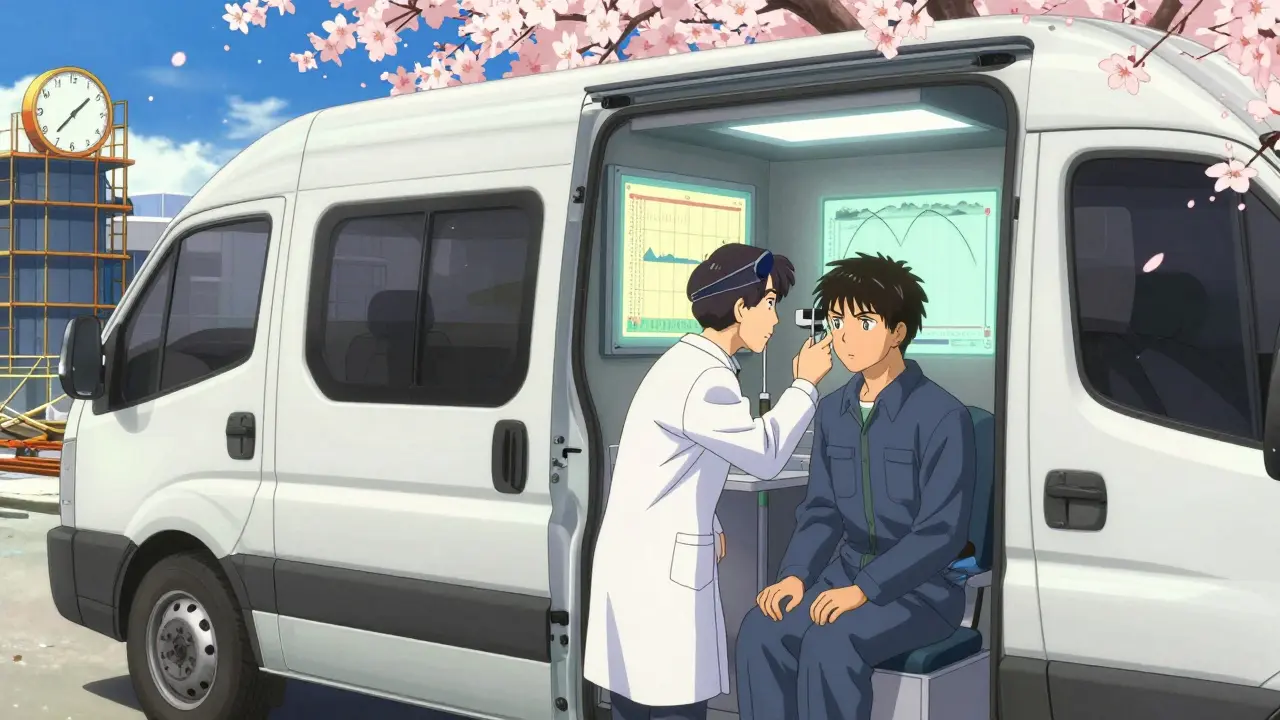
Successful companies use mobile testing units. These are vans or portable booths that come to the worksite. They cut down on lost work time by 60% and boost participation rates from under 50% to over 85%. Companies using them are 73% more likely to pass OSHA audits.

What’s Changing in 2024-2025?
The rules are catching up to science. OSHA is moving to update its standards, and the changes are significant:
- Calibration must follow ANSI S3.6-2018, not the outdated 1969 version.
- Test frequencies will expand to include 4000 Hz and 6000 Hz - crucial for detecting early hearing loss.
- Hearing protectors must now be matched to exposure levels above 100 dBA, not just capped at 90 dBA.
These changes will raise costs by 8-12%. But experts say they’ll prevent 150,000 new cases of hearing loss every year. That’s not just compliance - it’s saving people’s quality of life.
The Real Cost of Doing Nothing
22 million workers are exposed to hazardous noise each year. That’s a $1.5 billion market in hearing conservation services. But behind every number is a person who can’t hear their child laugh, can’t enjoy music, or can’t hear a warning shout on the job.
Dr. Thais C. Morata from NIOSH says it plainly: “Early detection and proper protection can prevent permanent hearing damage in 75% of at-risk workers.” That’s not a guess. That’s data.
Meanwhile, OSHA issued 1,842 citations in 2022 alone - up 17% from 2020. Fines? Up to $156,259 per violation. That’s not just a slap on the wrist. That’s a business risk.
And here’s the kicker: OSHA’s own evaluation found that only 58% of manufacturing plants and 42% of construction sites fully comply. That means more than half are breaking the law - and putting workers at risk.
It’s not about fear. It’s about responsibility. A working hearing is not a luxury. It’s a right. And for employers, a strong HCP isn’t just a legal requirement - it’s a smart investment.
Is a Hearing Conservation Program required for all workplaces?
No. Only if employees are exposed to noise at or above an 8-hour time-weighted average of 85 decibels (dBA). If noise levels are consistently below that threshold, a formal HCP isn’t required by OSHA. But even then, it’s still wise to monitor exposure and offer protection if workers report discomfort.
Can I use any earplug or earmuff for hearing protection?
No. Hearing protectors must reduce exposure to at least 90 dBA over an 8-hour shift. But more importantly, they must be appropriate for the noise level. A low-NRR (noise reduction rating) earplug won’t help in a 110 dBA environment. Employers must provide multiple types - foam plugs, silicone plugs, earmuffs - and let workers choose what fits best. Fit testing is now a best practice to ensure effectiveness.
How often must audiometric testing be done?
A baseline test must be done within six months of a worker’s first exposure at or above 85 dBA. After that, annual tests are required. The test must be conducted in a quiet, controlled environment using a calibrated audiometer. Workers must be free from workplace noise for at least 14 hours before the test to ensure accuracy.
What is a Standard Threshold Shift (STS), and what do I do if one is found?
An STS is a hearing loss of 10 dB or more at 2000, 3000, and 4000 Hz compared to the baseline audiogram. If detected, you must notify the employee in writing within 21 days, retrain them on proper hearing protector use, offer better protection if needed, and refer them for a clinical evaluation if a medical issue is suspected. If the shift is confirmed as permanent, the baseline can be updated to reflect the new hearing level.
Can I skip audiometric testing if workers wear hearing protection?
No. Hearing protection reduces risk but doesn’t eliminate the need for monitoring. Audiometric testing detects early changes that protection might not fully prevent. Skipping tests is a major OSHA violation. Even if everyone wears earplugs, you still need annual testing to catch problems before they become permanent.
Are there penalties for not having a Hearing Conservation Program?
Yes. OSHA fines range from $15,625 to $156,259 per violation, depending on severity and whether it’s willful or repeated. In 2022, over 1,800 citations were issued for HCP violations. Beyond fines, failing to protect hearing can lead to worker compensation claims, lawsuits, and reputational damage. It’s far cheaper to comply than to fight a citation.
Chris Bird
March 11, 2026 AT 02:50Let’s cut the fluff. If your noise level hits 85 dBA, you’re legally required to act. No excuses. I’ve seen factories skip monitoring because ‘it’s too expensive.’ Then a worker files a claim because he can’t hear his kid call him dad. Cost? Way more than a dosimeter. Simple math.
Training? Half the guys I worked with thought earplugs were for ‘weaklings.’ They’d shove ‘em in like a burrito, then wonder why they still heard the drill. No one teaches them how to fit ‘em right. That’s on the employer.
OSHA’s not out to get you. They’re out to keep your ears from dying slowly. And if you’re one of those ‘I don’t need this’ guys? Your hearing’s already gone. You just don’t know it yet.
Bridgette Pulliam
March 11, 2026 AT 04:22Thank you for laying this out so clearly. I’ve worked in manufacturing for 18 years, and I’ve seen the quiet ones-the ones who stop saying ‘huh?’ during meetings, who turn up the TV until the neighbors complain, who stop going to concerts because it’s too loud. This isn’t just about compliance. It’s about dignity.
One thing I wish more companies did: let workers pick their own protection. Not all foam plugs work for everyone. Some need silicone. Some need earmuffs with Bluetooth. Giving choice = higher compliance. And honestly? It’s just kind.
Miranda Varn-Harper
March 13, 2026 AT 00:17Let me get this straight. You’re telling me a company that runs a $250,000 annual safety budget can’t afford to test 20 workers’ hearing? Please. The real issue isn’t cost-it’s leadership. If your CEO can’t see the value in preserving someone’s ability to hear their grandchild, then you’ve got bigger problems than OSHA citations.
And let’s be honest: the 2024 updates are barely a step forward. 6000 Hz? That’s barely scraping the surface of high-frequency hearing loss. Real science demands 8000 Hz testing. But hey, maybe we’ll get there after another 50 years of bureaucratic inertia.
Tom Bolt
March 14, 2026 AT 18:01There is a critical grammatical error in the original post. The phrase ‘noise at or above 85 decibels (dBA) over an 8-hour shift’ is technically inaccurate. It should read ‘an 8-hour time-weighted average exposure of 85 dBA.’ The omission of ‘time-weighted average’ fundamentally misrepresents the regulatory standard. This is not pedantry-it is foundational to compliance. Misuse of terminology in regulatory contexts leads to systemic failure.
Additionally, the term ‘calibrated audiometer’ is insufficiently precise. It must specify compliance with ANSI S3.6-2018, as referenced later. Inconsistencies like this erode credibility. I am not a lawyer, but I know precision matters when lives are at stake.
Denise Jordan
March 15, 2026 AT 15:09Ugh. Another wall of text. Can we just say: if it’s loud, give ‘em earplugs and call it a day? Why do we need five components? A baseline? A retest? A 14-hour quiet rule? That’s a nightmare for swing shift workers. I’ve seen people show up after a rock concert and still get tested. It’s not practical. OSHA’s just trying to make paperwork look important.
Gene Forte
March 16, 2026 AT 03:12Listen-this isn’t about rules. It’s about people. Every worker deserves to hear their child’s first word. To laugh without straining. To know when someone says ‘watch out’ before the machine hits. That’s not a perk. That’s human.
Yes, it costs money. But think of it like this: if you spent $300 to keep someone’s hearing for 30 years, wouldn’t you? We fix brakes on cars. We check smoke alarms. Why do we wait until someone can’t hear their own name before we act?
Mobile testing units? Brilliant. They’re not just cheaper-they’re kinder. They meet people where they are. And that’s the kind of leadership that changes lives. Not fines. Not checklists. Humanity.
Kenneth Zieden-Weber
March 18, 2026 AT 00:45Oh wow. So the real villain here isn’t the noise-it’s the people who think ‘training’ means handing out a PDF and saying ‘read this.’
Let me guess: the guy who’s been deaf in one ear for five years? He’s still ‘compliant’ because he wears earplugs… even though he can’t hear the damn thing fitting right. And the boss? He’s proud he checked the box.
Meanwhile, the guy who just got his first STS? He’s being told to ‘try harder’ with his plugs. Not ‘let’s get you a better fit.’ Not ‘let’s see if this is medical.’ Just… more paperwork.
It’s not a program. It’s a performance. And we’re all acting like it’s real.
David L. Thomas
March 18, 2026 AT 15:00From a clinical perspective, the expansion to 6000 Hz is long overdue. High-frequency hearing loss is the earliest detectable marker of noise-induced damage. Most HCPs still use 2000–4000 Hz, which misses 40% of early cases. The ANSI S3.6-2018 calibration update is also critical-older equipment drifts by 3–5 dB over time, creating false negatives.
And let’s not forget: the 14-hour quiet period isn’t arbitrary. It’s based on temporary threshold shift (TTS) recovery kinetics. If you test too soon after noise exposure, you’re not measuring permanent damage-you’re measuring fatigue. That’s not just bad practice. It’s malpractice.
Companies that treat this as a compliance chore are gambling with neurosensory integrity. The data doesn’t lie: early intervention reduces progression by 70%. But you need precision. Not paperwork. Precision.