What Are Generic Substitution Laws?
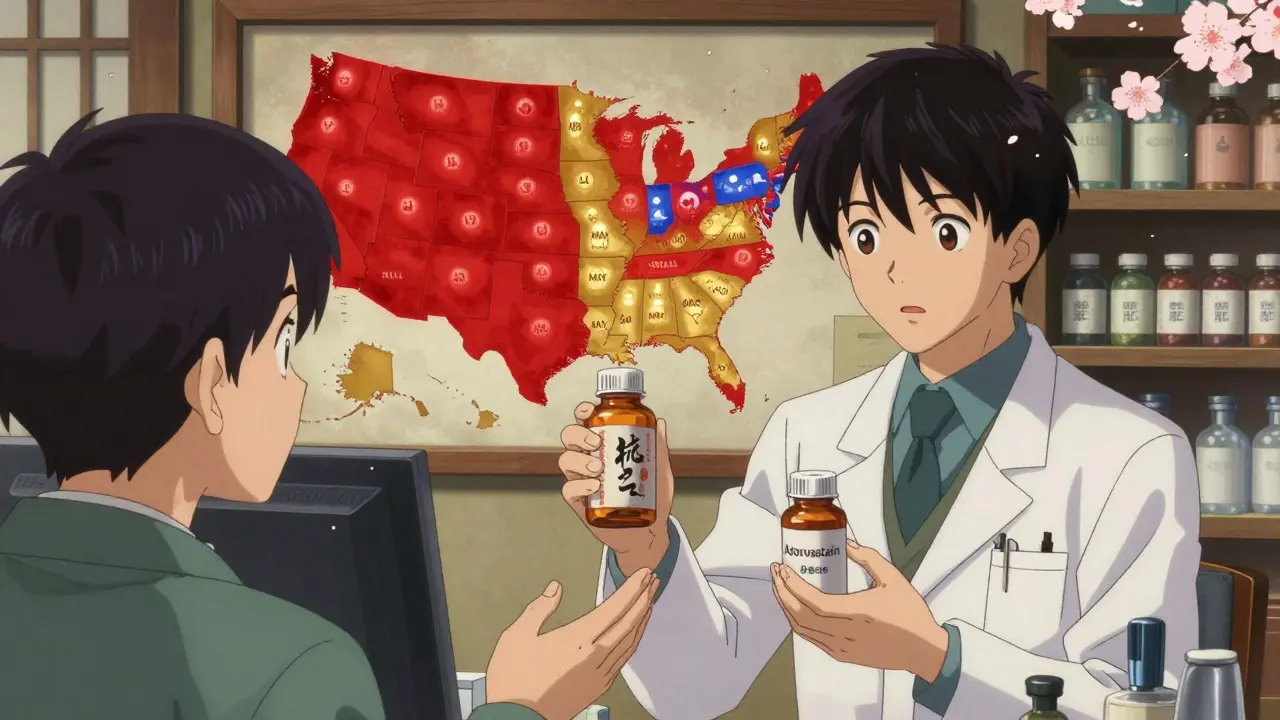
Generic substitution laws tell pharmacists when they can swap a brand-name drug for a cheaper, FDA-approved generic version. These aren’t federal rules - each state sets its own. That means if you fill a prescription in New York, the rules might be totally different than if you fill the same one in Texas. The goal is simple: save money without risking your health. Generic drugs have the same active ingredients, strength, and dosage form as brand-name drugs. The FDA says they work the same way. But state laws decide whether a pharmacist can make the switch without asking you first.
States That Require Substitution
Nineteen states, including California, New York, and Texas, require pharmacists to substitute generic drugs when they’re available - unless the doctor says not to. This is called a "shall" law. In these states, the pharmacist is expected to swap the brand for the generic unless there’s a clear reason not to. This keeps costs down. For example, a 30-day supply of the brand-name drug Lipitor might cost $400, but the generic atorvastatin costs $12. That’s a 97% drop. In states with mandatory substitution, generic use is 8-12% higher than in states where substitution is optional. That translates to $50-$150 saved per prescription, according to the Federal Trade Commission.
States That Allow But Don’t Require Substitution
Thirty-one states and Washington, D.C. let pharmacists substitute generics, but they don’t force them to. These are "may" laws. In these places, the pharmacist can choose to switch the drug, but they don’t have to. Some of these states add extra steps. Alaska, Delaware, Maine, and New Hampshire require pharmacies to post signs saying substitution is possible. That’s meant to inform patients, but it doesn’t guarantee they’ll get the cheaper option. In practice, this leads to inconsistent outcomes. A patient might get the generic in one pharmacy and the brand in another, even if they’re right next door.
When Do You Need to Give Consent?
Seven states - Connecticut, Hawaii, Maine, Maryland, New Hampshire, Vermont, and West Virginia - plus Washington, D.C., require you to give explicit consent before a generic can be swapped in. That means the pharmacist has to ask you, in person or over the phone, and you have to say yes. Hawaii takes it further: for antiepileptic drugs, they need consent from both you and your doctor. Why? Because some drugs, like seizure medications, have a narrow therapeutic index. That means even tiny differences in how your body absorbs the drug can cause problems. But for most other drugs, the FDA says generics are just as safe. Still, these consent rules slow things down. A 2022 study in the American Journal of Managed Care found that patients in states requiring consent used generics 12.7% less than in states without that hurdle.
What Happens After the Swap?
Thirty-one states and Washington, D.C. require pharmacists to notify you after they’ve substituted a drug - even if they didn’t need your permission first. This usually means a printed note on the prescription label or a quick verbal heads-up. But many patients don’t notice. A 2022 survey by the National Psoriasis Foundation found that 42% of patients on biologic drugs didn’t realize their medication had been switched to a biosimilar. That’s a problem if you’re tracking side effects or costs. Some states, like Oklahoma, go even further: they require the prescriber or the insurance company to give permission before any substitution can happen. That puts the power in the hands of doctors or insurers, not pharmacists or patients.
Who’s Liable If Something Goes Wrong?
Twenty-four states - including Alabama, Arizona, Illinois, Massachusetts, Missouri, Nebraska, New Mexico, Oregon, and Rhode Island - don’t offer pharmacists clear legal protection if a substituted drug causes an issue. That means if you have a bad reaction after a generic is swapped in, the pharmacist could be sued. That fear makes some pharmacists hesitant to substitute, even when the law allows it. One pharmacist in a multi-state chain told a Reddit community, "I have to constantly check which state’s rules apply when filling prescriptions for patients who live near state borders - it’s a nightmare for workflow efficiency." In states without liability protection, delays in substitution are common, especially for drugs like warfarin or levothyroxine, where small changes in dosage can be dangerous. Kentucky’s Board of Pharmacy logged over 1,200 substitution-related incidents in 2022, mostly involving these high-risk drugs.
Biologics and Biosimilars: A Different Ballgame
Biologic drugs - like Humira, Enbrel, or insulin - are complex molecules made from living cells. They’re expensive. Biosimilars are their cheaper, near-identical cousins. But substitution rules for these are much stricter. Forty-five states have tougher rules for biosimilars than for regular generics. Nine states require patient notification for biosimilars but not for regular generics. Six states that mandate generic substitution still treat biosimilars as optional. And every state that allows biosimilar substitution requires the FDA to label it as "interchangeable." That’s a higher bar than just "therapeutically equivalent." Plus, 48 states and D.C. require pharmacists to notify the prescribing doctor within 2-7 days after swapping a biologic. That’s a lot of paperwork. As a result, biosimilars make up only 11.2% of biologic prescriptions as of mid-2023, even though they can save hundreds or thousands per dose.
How Pharmacists Keep Up
Pharmacists don’t just memorize 51 different sets of rules. They use tools. Epic Systems, the biggest electronic health record platform, built a "State Substitution Rules Engine" in 2019. It automatically applies the right rules based on where the pharmacy is located. That cut substitution errors by 37%, according to their internal audit. The National Association of Boards of Pharmacy offers an interactive map updated every quarter. The FDA’s Orange Book app gives real-time info on whether a generic is approved for substitution. Still, pharmacists in border areas spend 8-12 extra hours a year just staying current. The National Community Pharmacists Association found that 68% of independent pharmacists spend 15-30 minutes a day just managing substitution paperwork and questions.
Why This Matters for You
If you take a generic drug, you might not even know you’re getting one. But if you’re on a biologic, or a drug with a narrow therapeutic index, you should. Ask your pharmacist: "Was this drug substituted?" Check your label. If you’re on a medication like levothyroxine, warfarin, or an antiepileptic drug, don’t assume the generic is interchangeable. Even small differences can affect how your body responds. And if you move to a new state, your prescription might suddenly be handled differently. In states with mandatory substitution, you’ll get the generic by default. In states with consent rules, you might need to ask for it. Your savings depend on where you live.
What’s Changing in 2026?
Twelve states introduced the "State Harmonization of Generic Substitution Act" in 2023 - a push to align rules across state lines. The FDA updated its Orange Book in 2022 to include new "interchangeability" designations for complex generics. Eighteen states are reviewing their laws because of that. A 2023 study in Health Affairs showed that states that simplified their laws between 2018 and 2022 saw generic use jump by 6.8 percentage points - and up to 11.2% in states that dropped consent requirements. The Congressional Budget Office estimates that without standardization, the U.S. will waste $4.7 billion a year on avoidable brand-name drug use by 2030. Right now, 27 states are actively considering reforms. The big question isn’t whether substitution works - it’s whether we can make the rules simple enough for everyone to understand.
Can my pharmacist switch my brand-name drug to a generic without telling me?
In 31 states and Washington, D.C., pharmacists must notify you after the switch, even if they didn’t need your permission. But in 7 states plus D.C., they need your consent before swapping. In 19 states, they’re required to substitute by law - and they may not always tell you unless you ask. Always check your prescription label and ask your pharmacist if you’re unsure.
Are generic drugs really as safe as brand-name drugs?
Yes. The FDA requires generics to have the same active ingredient, strength, dosage form, and route of administration as the brand. They must also be absorbed into the body at the same rate and extent. For most drugs, this means they work the same. But for drugs with a narrow therapeutic index - like warfarin, levothyroxine, or certain seizure meds - even tiny differences can matter. That’s why some states restrict substitution for these.
Why do some states ban substitution for antiepileptic drugs?
Antiepileptic drugs have a narrow therapeutic index, meaning the difference between an effective dose and a toxic one is small. Even minor changes in how your body absorbs the drug can trigger seizures. States like Hawaii and Kentucky restrict substitution for these drugs unless both you and your doctor agree. The American Epilepsy Society supports these rules to protect patient safety, even if it means higher costs.
Can I ask my pharmacist to give me the brand-name drug instead of the generic?
Yes. You can always ask for the brand-name drug, even if the law allows substitution. But you’ll likely pay more. Some insurance plans charge a higher copay for brand-name drugs if a generic is available. Your pharmacist can tell you the cost difference. If you’re concerned about switching, talk to your doctor - they can write "dispense as written" or "no substitution" on the prescription.
Do Medicare or Medicaid force generic substitution?
Medicaid programs in 42 states require generic substitution for most drugs and offer lower copays for generics. Medicare Part D plans also encourage generics, but they don’t force substitution. Instead, they use tiered pricing - generics are cheaper. So while you’re not legally forced to take a generic under Medicare, your out-of-pocket cost makes it the obvious choice.
How do I know if my drug is eligible for substitution?
Check the FDA’s Orange Book, available as a free mobile app. It lists drugs with therapeutic equivalence ratings. If a generic is rated "AB," it’s considered interchangeable with the brand. If it’s rated "BX," it’s not considered equivalent and can’t be substituted. Your pharmacist can also look this up for you. Don’t rely on the label alone - some drugs look similar but aren’t interchangeable.
What to Do Next
If you take a generic drug, keep track of how you feel. If you notice new side effects or your condition changes after a refill, ask if the drug was switched. If you’re on a high-risk medication, ask your doctor to write "do not substitute" on your prescription. If you live near a state border, check your state’s substitution laws - they might be different than your neighbor’s. Use the FDA’s Orange Book app to verify if your generic is rated "AB." And if you’re unsure, just ask. Pharmacists are trained to explain this stuff. You don’t have to guess.
Lorena Druetta
February 4, 2026 AT 05:43It’s amazing how much variation there is between states. I had no idea my pharmacist in California could swap my meds without asking, but my cousin in Hawaii has to sign paperwork every time. I’m just glad we’re even talking about this - patients deserve to know what’s in their pills.
Thank you for breaking this down so clearly. It’s not just about cost - it’s about safety, consistency, and dignity in care.
rahulkumar maurya
February 4, 2026 AT 16:40How quaint. You Americans treat pharmacy like a constitutional rights debate. In India, generics are the default - no forms, no consent, no drama. If your body can’t handle a 97% cheaper version of the same molecule, perhaps your physiology is the problem, not the law.
Stop romanticizing bureaucracy. The FDA doesn’t care about your state’s drama. The molecule doesn’t care where you live.
Alec Stewart Stewart
February 5, 2026 AT 14:31Man, I used to work in a pharmacy in Ohio - we had to check the state rules every time someone came in from Kentucky. One guy showed up with a script from Indiana and got mad because we gave him the generic. He didn’t even know his insurance paid $0 for it.
Just ask. Seriously. Pharmacist’s not trying to trick you. We’re just trying to not get sued or fired. 😅
Also - if you’re on levothyroxine? Always check the label. Even small switches can mess with your TSH. I’ve seen it.
Jamillah Rodriguez
February 7, 2026 AT 00:15Okay but why does it feel like every time I get my prescription, I’m being interrogated by a pharmacist who’s also doing a state law quiz? 🙄
I just want my pills. Not a 10-minute lecture on interstate pharmaceutical policy. Can’t we just… make one rule? 😭
Susheel Sharma
February 7, 2026 AT 19:13Let’s be real - this whole system is a clown show. You’ve got states requiring consent for antiepileptics while letting pharmacists swap out warfarin without blinking. That’s not patient safety - that’s cognitive dissonance dressed up as legislation.
And don’t get me started on biosimilars. We’re treating them like rare artifacts when they’re just expensive generics with extra paperwork. The FDA’s ‘interchangeable’ label is a marketing gimmick, not a medical standard. 48 states require doctor notification? That’s not healthcare - that’s administrative theater.
Janice Williams
February 8, 2026 AT 01:08And yet, somehow, we still let pharmacists make life-altering decisions without oversight. This isn’t ‘cost-saving’ - it’s pharmaceutical roulette. Who authorized them to be de facto doctors? And why are we praising states that force substitution as ‘progress’? Progress isn’t forcing people to take drugs they didn’t consent to.
What happened to patient autonomy? This is dangerous. And irresponsible. And frankly, unethical.
Alex LaVey
February 9, 2026 AT 11:25Just wanted to say - if you’re reading this and you’re scared about your meds being switched, you’re not alone. I’ve been there. I took levothyroxine for years and didn’t realize they’d switched me until my heart started racing.
It’s okay to ask. It’s okay to say no. It’s okay to check the label. Your health isn’t a line item on a spreadsheet. And pharmacists? Most of them are just trying to do right by you - even if the system is broken.
Be kind. Be loud. Be informed. You’ve got this. 💪
caroline hernandez
February 10, 2026 AT 10:01From a clinical pharmacy standpoint, the real issue is therapeutic equivalence grading. AB-rated generics are bioequivalent, yes - but for narrow-therapeutic-index drugs, even ±10% AUC differences can trigger adverse events. The FDA’s Orange Book is the gold standard, but many community pharmacists don’t routinely cross-reference it with prescriber intent or patient history.
What’s missing is a standardized EHR-integrated decision support layer. Without it, you’re relying on human memory and fragmented state laws - which is a system failure, not a policy gap. We need interoperable clinical rules engines, not patchwork state statutes.
Jesse Naidoo
February 11, 2026 AT 15:12You all act like this is new. I’ve been getting switched meds since 2015. I’ve had my blood pressure meds swapped, my antidepressants swapped, even my insulin - and no one told me until I asked. Now I check every single time. But I’m tired. I’m so tired of being the one who has to fight for basic transparency.
Why is it my job to police my own medicine? I pay taxes. I pay premiums. I shouldn’t have to be a detective just to get what I was prescribed.
Katherine Urbahn
February 13, 2026 AT 10:50Let me be unequivocal: The notion that pharmacists - who are not physicians - may unilaterally substitute life-sustaining medications without patient consent is an abomination of medical ethics. This is not ‘cost-saving’ - it is institutionalized negligence. The FDA’s ‘therapeutic equivalence’ designation is a statistical construct, not a clinical guarantee. And to suggest that patients should ‘ask’ for the brand - as if they have the knowledge, time, or leverage - is to insult their autonomy.
There is no justification for this. None. It must be abolished - immediately.
Joseph Cooksey
February 14, 2026 AT 17:55Look - I get it. You want to save money. I get that. But here’s the thing nobody’s talking about: The whole system is designed to make you feel like you’re getting a deal, when really, you’re just being shuffled through a maze of legal loopholes that benefit insurers, PBMs, and big pharma’s generic divisions - not you.
Think about it: Why do biosimilars need 48 states to notify doctors? Because they’re not *really* interchangeable. They’re just cheaper. And the FDA’s ‘interchangeable’ label? That’s a political compromise, not a scientific one. The same companies that make the brand-name drugs often own the biosimilars too. So who’s really winning here?
And don’t even get me started on how pharmacies in border towns are forced to run three different software systems just to avoid lawsuits. That’s not efficiency - that’s chaos. And it’s costing lives. We’re not talking about aspirin here. We’re talking about drugs that regulate your heart, your seizures, your thyroid - and we’re letting a cashier decide what you get based on what’s cheapest.
It’s not just broken. It’s predatory. And we’re all just pretending we’re okay with it.
So go ahead. Ask your pharmacist. Check your label. But don’t fool yourself - this isn’t healthcare. It’s a market-driven performance, and you’re the audience - and the product.