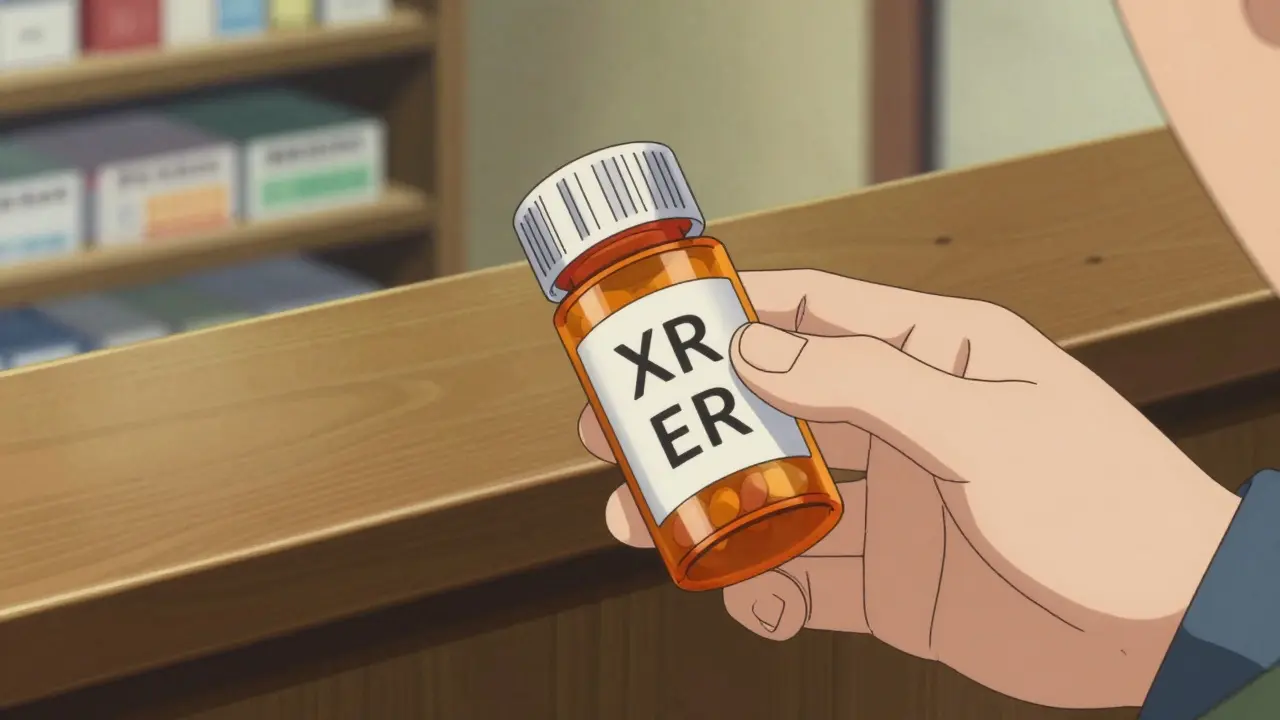
Imagine taking a pill that is designed to leak a tiny bit of medicine into your bloodstream every hour for a full day. Now imagine accidentally crushing that pill into a powder. Instead of a slow drip, your body gets a massive, potentially lethal flood of the drug all at once. This isn't a theoretical scenario; the FDA's MedWatch database has tracked over a thousand adverse event reports where people mishandled these specialized drugs. Understanding the specific language on a prescription label can literally be the difference between a stable recovery and a trip to the emergency room.
| Suffix | Full Name | What it Usually Means |
|---|---|---|
| ER / XR | Extended Release / eXtended Release | The drug is released slowly over a long period (often 24 hours). |
| SR | Sustained Release | Prolongs the release of the drug from the tablet or capsule. |
| CR | Controlled Release | Maintains a specific concentration of the drug in the blood. |
| CD | Continuous Delivery | A steady, constant flow of medication into the system. |
Decoding the Secret Language of Pill Names
When you look at your bottle, you'll notice the name of the drug isn't just a single word. It usually comes with a two-letter code at the end. Extended-Release Medications is a class of pharmaceutical formulations engineered to release active ingredients gradually over a predetermined timeframe rather than all at once.
If you see "XR" or "ER," your medication is designed to stay in your system much longer than a standard "immediate-release" (IR) pill. For instance, while a regular version of a blood pressure med might require you to take it three or four times a day, an extended-release version like Taztia XT (diltiazem) is designed to keep you covered for a full 24 hours with just one dose. These codes aren't just suggestions; they tell you exactly how the chemistry of the pill works. Whether it's a polymer matrix that slowly dissolves or a special coating that wears away over time, the suffix is your first clue that this pill behaves differently than a standard tablet.
Navigating the Drug Facts Panel and Prescription Labels
For over-the-counter options, the FDA requires a Drug Facts panel. This isn't just a list of ingredients; it's a structured map for your safety. When reading one, look specifically for the "Warnings" and "Directions" sections.
In the "Warnings" area, you are looking for the phrase "do not crush, split, or chew." If you see this, it means the pill has a specialized delivery system. Some use an OROS (Osmotic Release Oral System), which is essentially a tiny pump inside the pill. Others use encapsulation where the drug is inside a shell that dissolves at a precise rate. If you break that shell or crush the matrix, you destroy the "time-release" mechanism. You're essentially turning a 24-hour dose into a 0-second dose, which can lead to toxicity or overdose.
Check the "Directions" section for precise timing. Some extended-release drugs, like Niaspan (niacin), are specifically designed to be taken at bedtime to avoid side effects like skin flushing. Taking a 24-hour medication at the wrong time of day can lead to periods where you have no medicine in your system, or it can interfere with your sleep-like the case of users taking Adderall XR at night and staying awake for 36 hours.

The Danger Zone: What Never to Do with Your Medication
The biggest mistake people make is assuming that if a pill is too big to swallow, they can just cut it in half or crush it into applesauce. With immediate-release drugs, this is often fine. With extended-release drugs, it's dangerous. Institute for Safe Medication Practices (ISMP) warns that improper handling of modified-release forms can cause a "dose dump."
A dose dump happens when the entire day's worth of medicine hits your bloodstream at once. In severe cases, such as with opioid analgesics like OxyContin, this has led to near-fatal overdoses. Even if the drug isn't a narcotic, dose dumping can cause extreme side effects, such as a sudden drop in blood pressure or a dangerous spike in glucose levels. If you have trouble swallowing, do not take matters into your own hands. Ask your pharmacist if there is a liquid version or a different brand that is safe to split.
Comparing Extended-Release vs. Immediate-Release
It might be tempting to switch to the extended-release version because it's easier to remember one pill than four. While the convenience is real, there are trade-offs. Usually, these medications cost about 20% to 35% more than their immediate-release counterparts. More importantly, they are less flexible. If you have a bad reaction to an immediate-release pill, it leaves your system relatively quickly. An extended-release pill stays in your body for a long time, meaning if you have an adverse reaction, you can't simply "stop" the dose-the pill is already in your gut, slowly releasing the drug.
Here is a quick breakdown of how they differ in practice:
- Dosing Frequency: IR usually requires multiple doses; ER typically requires 1-2.
- Blood Levels: IR causes "peaks and valleys" in drug concentration; ER aims for a steady state.
- Adherence: ER versions typically see much higher patient compliance because they are easier to manage.
- Cost: ER is generally more expensive due to the complex engineering of the pill.
Pro Tips for Staying Safe and Organized
To make sure you're getting the most out of your medication without risking your health, follow these practical steps:
- The Teach-Back Method: When the pharmacist explains your medication, repeat the instructions back to them in your own words. Say, "So, I take this one pill every morning at 8 AM, and I must swallow it whole without chewing?" This confirms you both agree on the plan.
- Scan the QR Codes: Many new labels now feature QR codes. Scan them with your phone to find video instructions that show exactly how the medication should be taken.
- Read the Medication Guide: For high-risk drugs, the FDA mandates a paper Medication Guide (MG). Don't throw it away. It contains specific data on the pharmacokinetic profile of your drug-essentially how it moves through your body.
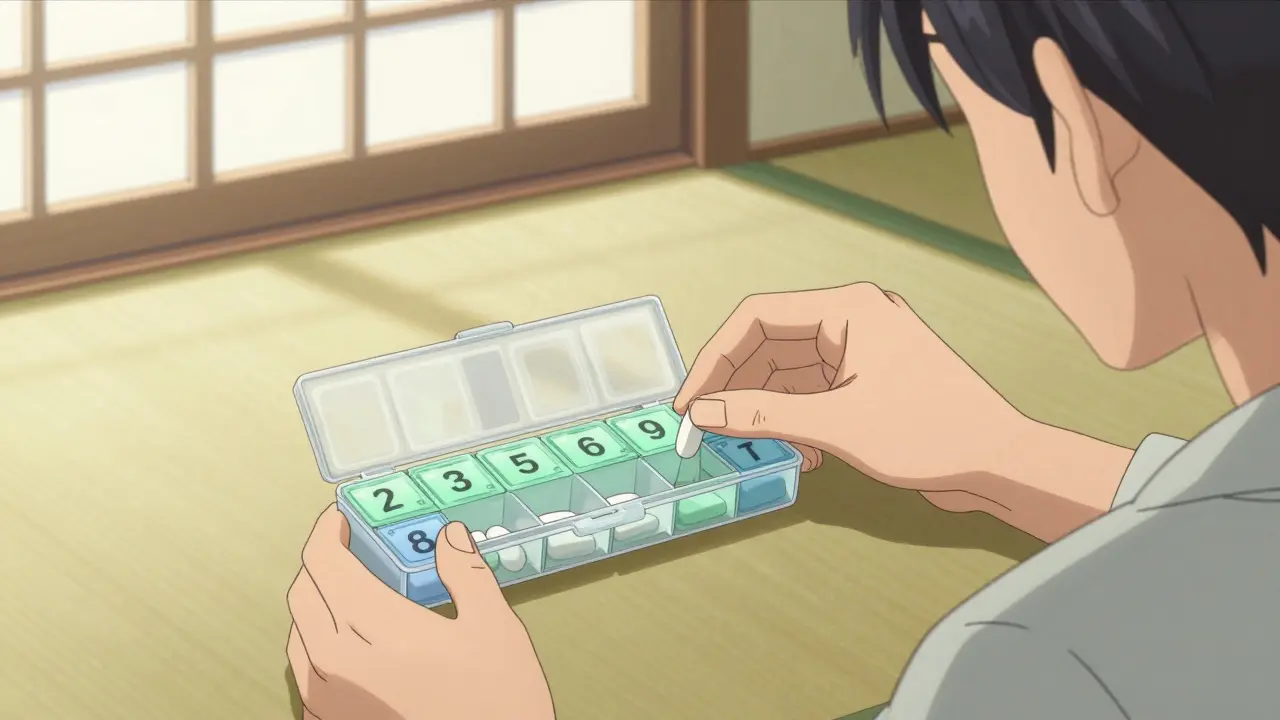
- Use a Pill Organizer: Because ER medications are often taken once daily, it's easy to forget if you took your dose. A simple M-T-W-T-F-S-S box prevents the dangerous mistake of double-dosing.
Can I crush an ER pill if I can't swallow it?
No. You should never crush, chew, or split a medication labeled as ER, XR, SR, or CR unless specifically told to do so by your doctor. Doing this destroys the time-release mechanism and can lead to a dangerous overdose known as a "dose dump."
What does "XR" actually stand for?
XR stands for "eXtended Release." It means the medication is formulated to be released slowly into your bloodstream over a long period, usually 24 hours, to reduce the number of times you need to take the drug.
Is there a difference between SR and ER?
Yes, although they are similar. ER (Extended Release) generally refers to a drug that is released over a very long period. SR (Sustained Release) specifically aims to prolong the release of the drug to maintain a constant level in the blood, though the exact duration can vary.
Why is the timing of my ER medication so important?
Timing matters because some ER drugs are designed to align with your body's natural rhythms or to minimize side effects. For example, some must be taken at night to avoid flushing, while stimulants like Adderall XR must be taken in the morning to avoid insomnia.
What should I do if I accidentally crushed my ER pill?
If you have already ingested a crushed extended-release pill, contact your doctor, a pharmacist, or a poison control center immediately. Because the dose is released all at once, you may experience an intense reaction or toxicity.
Kathleen Painter
April 10, 2026 AT 20:06It's so important to remember that we all have different needs when it comes to our health, and for some of us, the physical act of swallowing a large pill can be a real source of anxiety, so having this information laid out so clearly helps us feel more empowered to talk to our providers about alternatives. Maybe we can all just take a breath and realize that the pharmacist is there to support us, and it's perfectly okay to ask for a liquid version if the tablet feels like too much, because your mental well-being is just as vital as the chemical balance in your bloodstream, and we should all be patient with ourselves as we navigate these complex medical systems together in a way that feels safe and inclusive for every single body type.
Windy Phillips
April 12, 2026 AT 05:17One would think that basic reading comprehension would be a prerequisite for taking prescription medication... but apparently, not for everyone!!! It is truly exhausting to see how many people disregard the warnings printed in bold on their own bottles...
jack hunter
April 13, 2026 AT 03:07the whole concept of time release is just a social construct to make us depend on a single pill for 24 hours insted of owning our own rhythms and honestly who even trust the fda anyway they probably just want us in a daze so we dont notice the real world crumbling
Stephen Luce
April 15, 2026 AT 00:10I can totally see how scary it would be to accidentally crush one of these. Just a heads up to anyone feeling overwhelmed, your local pharmacist is usually way more chill than you'd think and they can help you figure out a better way to take your meds if the pills are too big.
shelley wales
April 15, 2026 AT 19:17This is such a helpful guide!
Timothy Burroughs
April 15, 2026 AT 23:44only in america do people need a manual to read a pill bottle we used to be a nation of strong people who knew how to handle their business without a qr code telling them how to swallow a tablet its pathetic honestly
Danielle Kelley
April 17, 2026 AT 17:47Don't trust the "special coatings"! They're just adding more chemicals to track how the drug moves through you and probably adding some kind of sedative to keep you compliant while they experiment with these "osmotic pumps" in your gut! Wake up people!
Christopher Cooper
April 18, 2026 AT 21:37The distinction between SR and ER is actually quite fascinating from a chemical engineering perspective. I wonder if there are new developments in biodegradable polymers that could make these delivery systems even more precise and reduce the cost gap between IR and ER versions.
Del Bourne
April 19, 2026 AT 10:20To add to the section on the "Teach-Back Method," it is also very useful to bring a written list of all your current supplements. Some vitamins or herbal teas can actually interfere with the absorption of extended-release coatings, which might lead to the medication being released too quickly or not at all. Always check for interactions, even with natural products, to ensure the delivery system works as intended by the manufacturer.
Nathan Kreider
April 21, 2026 AT 02:55I'm glad there are pill organizers mentioned. I used to forget my meds all the time, but a simple plastic box changed everything for me. It's a small thing that makes a huge difference in feeling better every day.