
Medication Side-Effect Relief Guide
Select the type of medication you are taking to discover the best prevention strategies and risk factors based on the article.
NSAIDs
e.g., Ibuprofen, Aspirin
Metformin
Diabetes Medication
Calcium Blockers
Blood Pressure Meds
Tetracyclines
e.g., Doxycycline
Bisphosphonates
Bone Density Meds
General Advice
Universal Tips
Medication Guide
Why it happens:
...
Prevention Strategy:
...
⚠️ Red Flags: Contact a Doctor Immediately if...
- You have difficulty swallowing (food/water feels stuck).
- You see blood in vomit or black, tarry stools.
- You experience severe, crushing chest pain radiating to the arm.
You take a pill to feel better, only to find yourself clutching your chest or dealing with a churning stomach an hour later. It's a frustrating cycle: the medicine you need to stay healthy is the same thing making you miserable. Whether it's a daily blood pressure pill or a round of antibiotics, medication-induced heartburn is more common than you might think. In fact, about 15-20% of heartburn cases that aren't caused by food are actually triggered by pharmaceuticals.
The good news is that you don't usually have to choose between your treatment and your comfort. Most of the time, a few simple changes in how you take your medicine can stop the burn. However, ignoring these symptoms can lead to serious issues like esophageal strictures or even Barrett's esophagus, especially if you're over 50. The goal is to keep your therapeutic progress on track without letting your digestive system pay the price.
| Medication Type | Likelihood of Heartburn/Upset | Primary Effect |
|---|---|---|
| NSAIDs (e.g., Ibuprofen) | 20-30% | Reduces protective stomach lining |
| Metformin | 20-30% | General GI irritation and nausea |
| Calcium Channel Blockers | 10-20% | Relaxes the esophageal sphincter |
| Tetracyclines (e.g., Doxycycline) | ~12% | Direct irritation (pill esophagitis) |
| Bisphosphonates | 5-10% | Severe esophageal injury risk |
Why Your Medicine Is Triggering Heartburn
Not all medications cause stomach issues in the same way. Understanding the "why" helps you pick the right solution. First, some drugs, like NSAIDs (Non-Steroidal Anti-Inflammatory Drugs), act like a chemical sandpaper. They block the production of prostaglandins, which are the natural chemicals that keep your stomach lining intact. Without that shield, your own stomach acid starts eating away at the tissue.
Then there are the "relaxers." Calcium Channel Blockers, often used for high blood pressure, work by relaxing smooth muscles. Unfortunately, they also relax the lower esophageal sphincter (LES)-the valve that keeps acid from splashing back up into your throat. When that valve stays open, you get that classic burning sensation in your chest.
Finally, some pills cause what's known as drug-induced esophagitis. This happens when a pill doesn't slide down quickly enough and gets stuck or lingers in the esophagus, causing a localized chemical burn. This is particularly common with antibiotics like Doxycycline, where symptoms often hit within a few hours of taking the dose.
Practical Ways to Prevent the Burn
You can often neutralize these side effects by changing your routine. For those taking medication induced heartburn triggers like ibuprofen or aspirin, the simplest fix is food. Taking these with a meal can reduce the incidence of heartburn by 40-50% because the food acts as a buffer between the drug and your stomach wall.
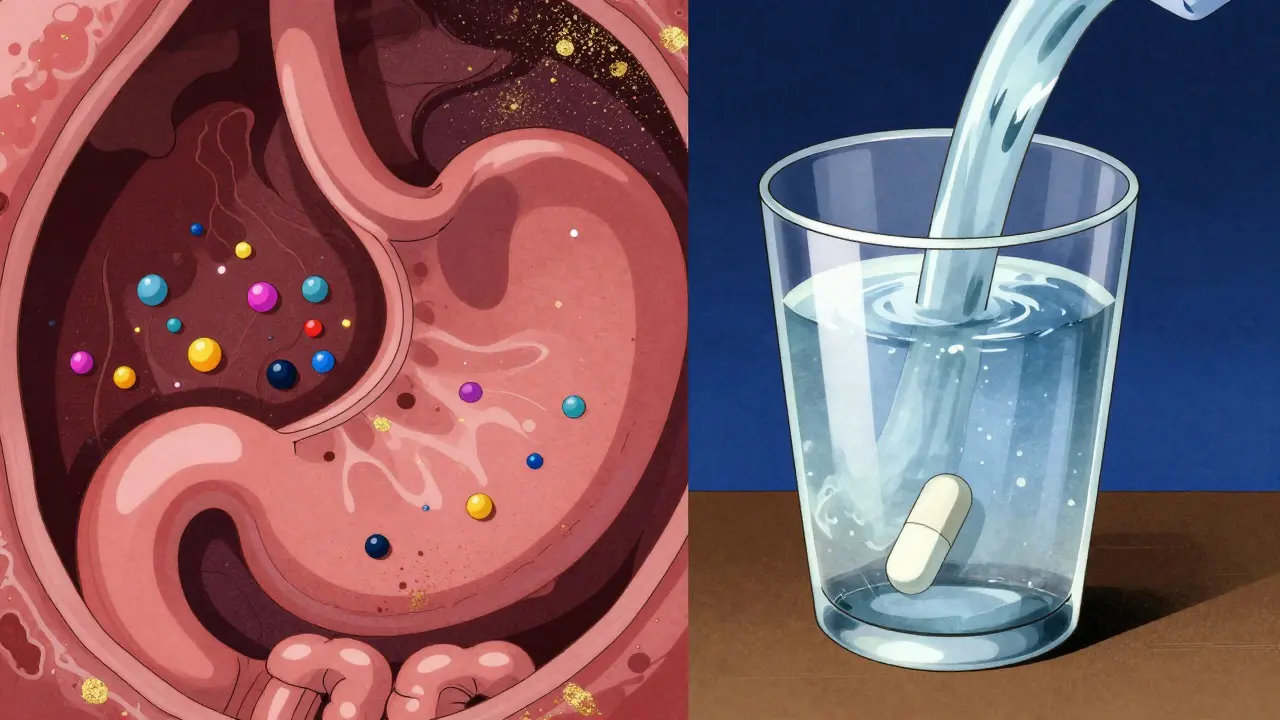
If you're on a regimen of tetracycline antibiotics or bone-density meds like bisphosphonates, water is your best friend. Drink a full 8oz glass of water with your pill to ensure it clears the esophagus and hits the stomach immediately. More importantly, stay upright. Remaining vertical for 30 to 60 minutes after dosing can prevent up to 90% of pill-induced esophagitis cases. Lying down immediately after a pill allows the medication to linger in the throat, which is essentially an invitation for an ulcer.
For those struggling with Metformin, patience is key. Unlike NSAIDs, where the pain persists as long as you take the drug, Metformin's GI side effects usually vanish within 2 to 4 weeks as your body adjusts. About 60-70% of patients find the nausea and heartburn disappear on their own if they stick with the treatment.
When to Use Over-the-Counter Support
Sometimes, behavioral changes aren't enough, and you need a bit of chemical help. Antacids taken about 30 minutes before an NSAID can lower the chance of heartburn by 30-40%. If the risk is higher-say, you're an older adult or have a history of ulcers-your doctor might suggest Proton Pump Inhibitors (PPIs) like omeprazole. These don't just neutralize acid; they shut down the pumps that produce it, reducing the risk of NSAID-induced ulcers by a massive 70-80%.
However, a word of caution: don't start a PPI or a heavy antacid regimen without asking your pharmacist first. Some medications can interfere with the absorption of others. For example, taking an antacid at the same time as certain antibiotics can make the antibiotic less effective, meaning you're dealing with the side effects but not getting the cure.
Red Flags: When It's More Than Just Heartburn
While a little reflux is annoying, some symptoms mean you need to call your doctor immediately. You shouldn't ignore "the burn" if it's accompanied by these signs:
- Difficulty swallowing: If food or water feels like it's getting stuck, you might have developed a stricture (a narrowing of the esophagus).
- Blood in vomit or stool: Dark, coffee-ground-looking vomit or black, tarry stools are signs of internal bleeding, often linked to chronic NSAID use.
- Severe chest pain: If the pain is crushing or radiates to your arm, it could be cardiac-related rather than digestive.
Crucially, never stop taking a prescribed medication-especially beta blockers or heart meds-without a doctor's guidance. Stopping some drugs abruptly can cause a "rebound effect" that is far more dangerous than a bit of heartburn.

The Future of Stomach-Friendly Meds
Science is moving toward a world where we won't have to deal with these trade-offs. The FDA has already approved delayed-release versions of certain antibiotics that bypass the esophagus, cutting exposure and irritation by nearly half. We're also seeing the rise of protective coatings on NSAIDs that reduce heartburn by over 30% in clinical trials.
Looking further ahead, doctors are exploring genetic testing to see who is most at risk. For instance, certain people have a variation in the CYP2C9 gene that makes them more susceptible to NSAID toxicity. By identifying these people early, doctors can prescribe alternatives that don't irritate the gut from day one.
Can I just take an antacid every time I take my medication?
Not always. While antacids help with NSAIDs, they can interfere with how your body absorbs other drugs, like certain antibiotics or antifungals. Always check with your pharmacist to see if there's a timing gap you need to maintain between your medication and your antacid.
Why does my blood pressure medication cause reflux?
Certain types, specifically calcium channel blockers, relax the smooth muscles in your body to lower blood pressure. This includes the lower esophageal sphincter, which acts as a one-way valve. When it relaxes too much, stomach acid can leak upward into your esophagus.
Is it safe to take Ibuprofen on an empty stomach if I use a PPI?
While a PPI significantly reduces the risk of ulcers, it's still better to take NSAIDs with food. Food provides a physical barrier and helps neutralize some acid immediately, providing a double layer of protection when combined with a PPI.
How long should I wait after taking a pill before lying down?
For most medications, 30 minutes is the minimum, but for high-risk pills like Doxycycline or bisphosphonates, you should remain upright for at least 60 minutes to ensure the pill has fully cleared the esophagus.
What should I do if I've already developed a swallowing problem?
You should contact a gastroenterologist immediately. Difficulty swallowing can indicate an esophageal stricture or severe esophagitis, which may require medical intervention or a change in how your medication is delivered (such as a liquid or injection).
Next Steps for Relief
If you're currently struggling, start by auditing your routine. Try the "water and upright" method for a week. If you're on NSAIDs, move them to a mealtime. If the burn persists, keep a simple log of when it happens and bring it to your next appointment. Your doctor can often switch you to a different class of drug-for example, moving from a calcium channel blocker to a beta blocker-that provides the same health benefit without the GI distress.
Carol Yang
April 26, 2026 AT 13:21Glad this is out there for people who don't know!
Hayley Redemption
April 28, 2026 AT 04:47The statistical distribution in that table is laughable. 15-20% is a vague range that screams 'I found this on a blog' rather than actual clinical data. It's honestly embarrassing that people think this is an exhaustive guide to pharmacology.
Ben Jima
April 29, 2026 AT 12:11If you're dealing with Metformin, definitely stick with it for those first few weeks. Your gut microbiome needs time to adjust to the change. It's a tough start, but the long-term benefits for your blood sugar are absolutely worth the temporary discomfort. Keep pushing forward!
Brittney Prince
April 30, 2026 AT 22:44The 'future of meds' section is such a joke. They just want us on more expensive 'delayed-release' garbage so they can charge more. It's all a racket to keep us dependent on the pharmacy while they ignore the real causes of gut issues.
William Zhigaylo
May 2, 2026 AT 11:06It is utterly reprehensible that the general public is encouraged to self-diagnose based on a superficial list of symptoms. The negligence inherent in suggesting an antacid before a pharmaceutical without a physician's explicit oversight is staggering. Your lack of rigor is offensive.
Gauri Parab
May 3, 2026 AT 18:27Imagine thinking that 'staying upright' is a medical strategy. Please. This is just common sense repackaged as a health tip for people who have zero critical thinking skills. The level of intellectual laziness here is simply staggering.
Nikita Shabanov
May 5, 2026 AT 13:09For those on calcium channel blockers, it's worth noting that the timing of your meals relative to the medication can also play a role. Some find that smaller, more frequent meals help reduce the reflux caused by the relaxed sphincter. It's a gradual process of trial and error.
Nila Sawyer
May 5, 2026 AT 21:09Wow, this is just so helpful and I'm so happy that there are ways to feel better while staying healthy! 🌟 I remember when I first started a new med and felt so scared about the stomach pain, but finding a little routine really changes everything! We all just need to support each other and keep our spirits high while we heal! ✨💖🌈
Jaclyn Vo
May 6, 2026 AT 04:01Ummm, hello?? Doxycycline is literally the worst thing ever to swallow! I once took it and felt like I had a flaming torch in my throat for three hours! 🙄 Like, why is this even a thing in 2024?? Absolute nightmare! 😱
James Harrison
May 6, 2026 AT 13:33It's funny how we treat the body like a machine where you just add a buffer here or a pump-blocker there. Maybe the discomfort is just the body's way of saying it doesn't like the chemistry we're forcing on it.
Michael Deane
May 7, 2026 AT 14:53The US medical system is such a mess that we have to read articles on how to not burn our throats while taking pills that probably cost ten times more than they do in other countries and half the time the docs don't even tell you about these side effects until you're already miserable which is just classic American healthcare for you!
sachin singh
May 9, 2026 AT 11:10This provides a very structured approach to managing medication side effects. I appreciate the clarity regarding the different mechanisms of action for each drug class.