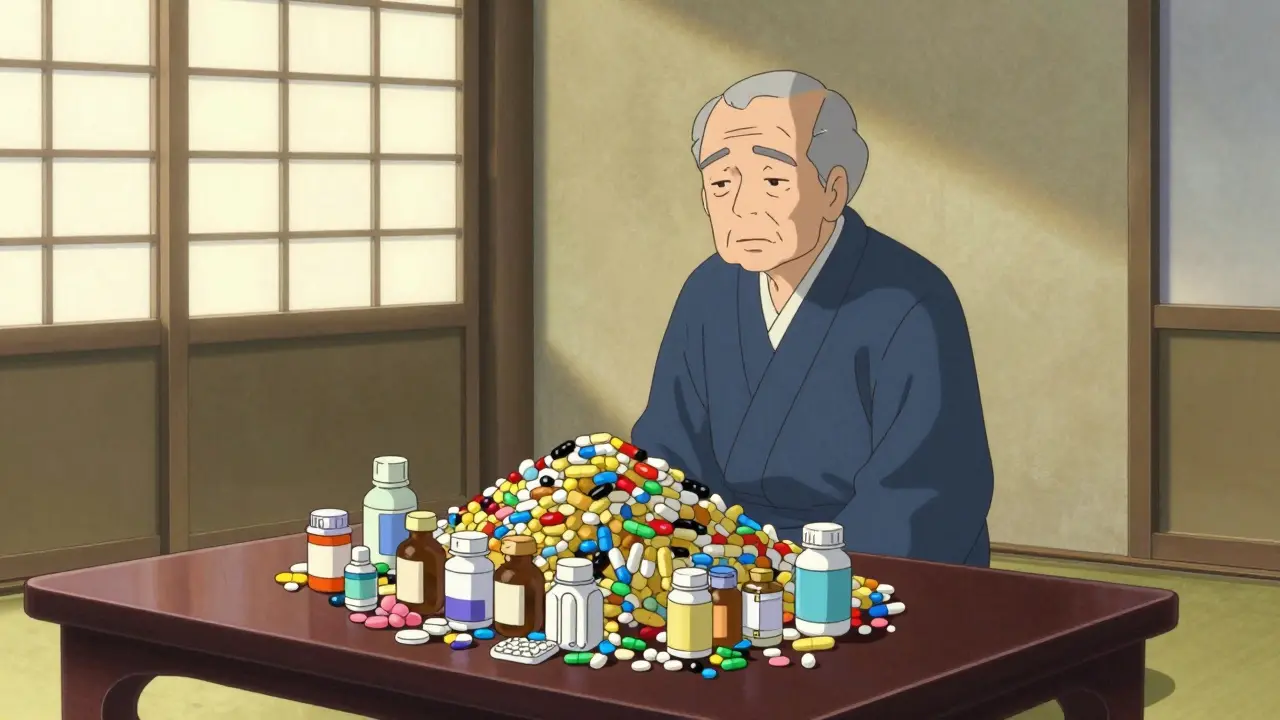
Reducing the number of medications an older person takes is a clinical process known as deprescribing is the planned and supervised process of reducing or stopping medications that may no longer be beneficial or may even be harmful. It is not about simply cutting pills; it is a strategic medical intervention to improve a person's quality of life. When the risks of a drug outweigh the benefits, staying on that medication is actually the riskier choice.
The Hidden Danger of Polypharmacy
When a person takes five or more medications daily, they are dealing with
polypharmacy
the concurrent use of multiple medications by a patient
. This isn't just a matter of convenience. The statistics are startling: in the US, the number of seniors taking five or more drugs tripled between 1994 and 2014, jumping from about 14% to over 42%. In Scotland, similar trends show a doubling of this population over a fifteen-year span.
Why does this matter? Because the older your body gets, the differently it processes chemicals. A dose that worked at age 50 might be toxic at age 80. This often leads to adverse drug events-think dizziness, confusion, or sudden falls-which can cost the healthcare system billions and, more importantly, strip a senior of their independence.
When Is It Time to Stop?
Not every medication is a candidate for removal. However, there are specific red flags that suggest a medication review is urgent. You should look closely at your prescriptions if any of the following apply:
- New, Unexplained Symptoms: If a senior suddenly seems confused, lethargic, or loses their balance, it might not be "just old age." It could be a side effect of a drug or a reaction between two different medications.
- Advanced Stage of Illness: When someone is facing terminal illness, severe dementia, or extreme frailty, the goal of care shifts. A medication meant to prevent a heart attack in ten years is useless if the person is currently struggling to breathe or eat.
- High-Risk Combinations: Some drugs are dangerous when paired together, increasing the risk of internal bleeding or severe kidney stress.
- Preventative Drugs with No Immediate Benefit: Some medications are prescribed to prevent a condition that might take years to develop. If the patient's life expectancy is short, these drugs often do more harm than good.
The Tools Experts Use to Decide
Doctors don't just guess which drugs to cut. They use evidence-based frameworks to identify Potentially Inappropriate Medications (PIMs) medicines that are more likely than not to cause harm than benefit in older adults . Two of the most trusted tools are the Beers Criteria a widely used guideline that lists medications that are generally avoided in older adults and the STOPP Criteria Screening Tool of Older Persons' Potentially Inappropriate Prescriptions, used to identify specific medicines to stop . These tools help clinical pharmacists and geriatricians pinpoint which drugs are causing the most trouble.
| Tool | Primary Focus | Best Used For... | Typical Outcome |
|---|---|---|---|
| Beers Criteria | Drug Lists | Identifying high-risk drugs globally | Avoidance of specific drug classes |
| STOPP Criteria | Patient-Specific | Screening individual prescriptions | Targeted deprescribing of specific pills |
| Pharmacist Review | Holistic Audit | Detecting drug-drug interactions | Dose reduction and regimen simplification |
How the Deprescribing Process Actually Works
Deprescribing is a surgical process, not a blunt one. If you stop five drugs at once, you'll have no idea which one was actually helping and which one was causing the problem. A safe approach follows these steps:
- The Audit: A doctor or clinical pharmacist lists every single pill, including over-the-counter vitamins and herbal supplements.
- Goal Setting: The patient and family decide what matters most. Is it mental clarity? Mobility? Pain management? This ensures the medical plan aligns with the person's values.
- The Taper: Instead of stopping cold turkey, the dose is slowly reduced. For example, someone on Proton Pump Inhibitors (PPIs) medications used to reduce stomach acid, often overused in seniors might reduce their dose over several weeks to avoid a rebound effect.
- Monitoring: The patient tracks any returning symptoms or new side effects. This requires a strong link between the hospital, the GP, and the home caregiver.
Overcoming the Fear of Stopping
The biggest hurdle in deprescribing is fear. Patients fear the return of symptoms, and doctors fear the liability of taking a drug away. But we must treat the act of stopping a drug as a positive therapeutic intervention. Just as a doctor treats a new drug as a "trial" to see if it works, they should treat the removal of a drug as a trial to see if the patient feels better.
Research shows that this structured approach pays off. When done correctly, deprescribing can reduce adverse drug events by up to 30% and cut hospital readmissions by as much as 25%. It isn't about taking away care; it's about giving back quality of life.
Is it safe to stop a medication without a doctor's help?
Absolutely not. Stopping some medications abruptly-such as certain blood pressure meds or antidepressants-can cause dangerous withdrawal symptoms or a "rebound" effect where the original condition returns more severely. Always consult a professional to create a tapering schedule.
How often should a senior have a medication review?
At a minimum, once a year. However, a review should happen immediately if there is a change in health status, a new diagnosis, a hospital discharge, or if the person begins showing signs of confusion or frailty.
What is a "prescribing cascade"?
This happens when a side effect of one drug is mistaken for a new medical condition, leading the doctor to prescribe a second drug to treat that side effect. This can continue indefinitely, leaving the patient on a dozen drugs when they only actually needed one.
Can a pharmacist help with deprescribing?
Yes. Clinical pharmacists are often the best-equipped professionals to spot drug-drug interactions and suggest dose reductions based on the latest evidence. They can provide the detailed audit needed before a doctor makes the final call to stop a drug.
Will stopping these meds make the original disease worse?
In some cases, a symptom might return. However, the goal of deprescribing is to balance that risk against the risk of the drug causing a fall, kidney failure, or cognitive decline. The decision is based on the patient's current life expectancy and daily function.
Next Steps for Caregivers and Seniors
If you suspect your loved one is over-medicated, start by creating a "Master List." Include the drug name, the dose, why it was prescribed, and when it was last reviewed. Bring this list to your next appointment and specifically ask the doctor: "Which of these medications are no longer serving their original purpose?"
If the doctor is hesitant, ask them to use the Beers Criteria to check for inappropriate prescriptions. Remember, the goal isn't to have zero medications, but to have the right medications for the person's current stage of life.
Amy Fredericks
April 23, 2026 AT 07:48This is such a helpful guide for anyone caring for aging parents! It's so easy to overlook how medications accumulate over time, and having a structured way to approach the conversation with doctors is a real game-changer.
I'm sure many families will feel more empowered after reading this.
Anastasios Kyriacou
April 25, 2026 AT 06:12too long didn't read basically just go to a doc
Mike Arrant
April 26, 2026 AT 12:41Listen, most of you are just too scared to tell your doctors they're messing up. I've seen this happen a dozen times where the family just rolls over and lets the MD prescribe whatever. You need to step in and take control of the medicine cabinet yourself if you actually care about your parents' sanity.
Dave Edwards
April 26, 2026 AT 22:37Absolutely scandalous that we even need a guide for this! 😱 It's a total failure of the medical system that 'prescribing cascades' are even a thing in the first place. How can anyone defend this level of incompetence? Total joke! 🙄
Ajinkya Joshi
April 27, 2026 AT 11:24Oh wow, a table comparing tools. How revolutionary. I'm sure the clinical pharmacists are just thrilled to be 'auditing' the pills while the patient slowly loses their mind from the side effects of the first five drugs.
Rick Brewster
April 27, 2026 AT 14:22one must consider that the very act of pharmacutical intervention is an attempt to stifle the natural entropy of the human condition and while deprescribing seems like a logical utility it is really just another layer of control over the inevitable decay of the corporeal form and frankly the obsesion with quality of life metrics is just a bourgeois distraction from the void we all face eventually anyway
Saptatshi Biswas
April 28, 2026 AT 22:52The statistics provided here for the US and Scotland are utterly irrelevant when you consider the systemic medical superiority we are achieving in India! Our traditional integration of care far outweighs these western 'criteria' that only serve to commodify the elderly into a set of checkboxes for a pharmacist's audit! It is an absolute tragedy that the West remains so blind to holistic efficiency while clinging to these clinical frameworks!
Chidi Prosper
April 29, 2026 AT 17:36I completely agree with the focus on goal setting here. It's vital that the patient's values lead the medical plan rather than just the clinical guidelines. Let's actually push for this to be the standard of care in every clinic!
Divyanshu Giri
May 1, 2026 AT 11:31Spot on stuff! Just keep pushing for that better life! Super brave to tackle the pill pile! Let's get those seniors feeling zingy again!
Dan Wizard
May 1, 2026 AT 19:42I find the concept of the 'prescribing cascade' to be a deeply concerning phenomenon, and while I appreciate the caution against stopping medications without professional help, I wonder if the systemic pressure on GPs to see patients quickly is what prevents these reviews from happening more frequently than once a year.
RAJESH MARAVI
May 3, 2026 AT 05:28Beers Critera is a joke lol. My uncle took a bunch of stuff and felt fine until he stopped the
Odicha ude Somtochukwu
May 3, 2026 AT 17:05I believe it is most prudent to follow the advice regarding the 'Master List' precisely... It ensures that no detail is overlooked during the consultation, and it fosters a spirit of cooperation between the caregiver and the physician!!
Ally Warren
May 4, 2026 AT 22:11There is a certain poetry in the idea of 'giving back' quality of life by taking away the very things we thought were providing it. It reminds us that health is often not about addition, but about the subtraction of the unnecessary to find the essence of well-being.