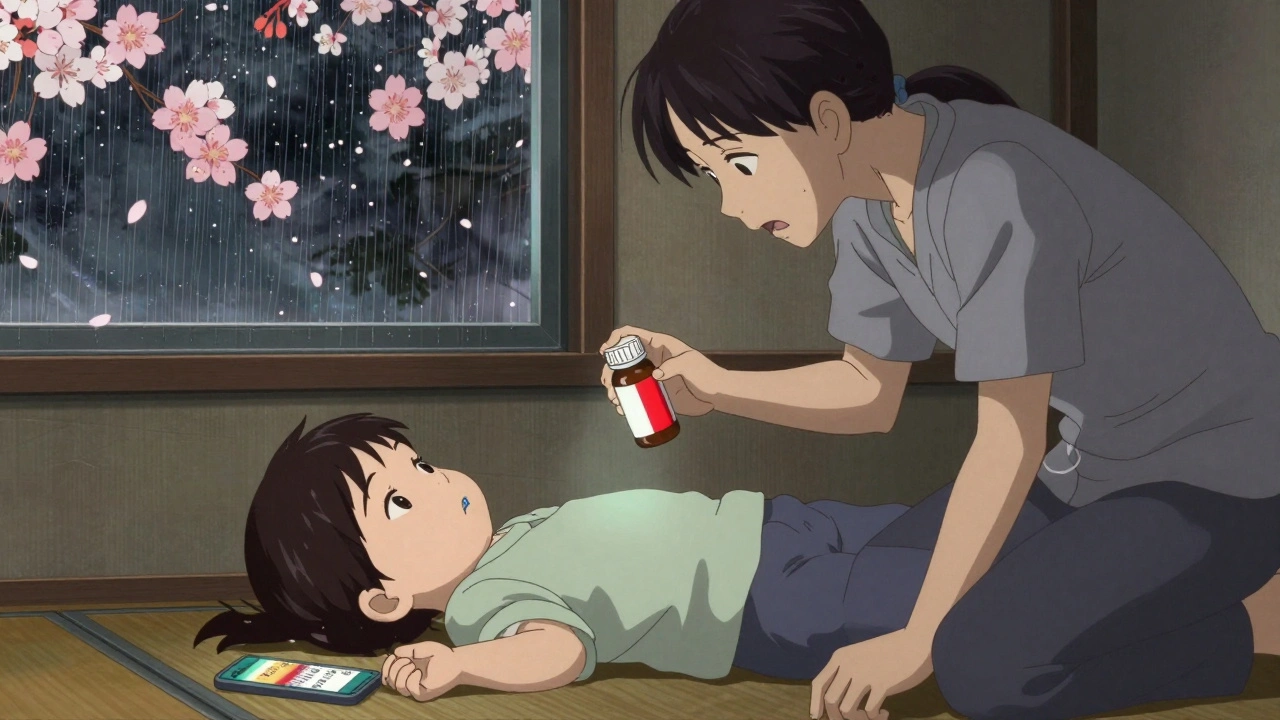
When a child accidentally swallows too much medicine, time isn’t just important-it’s everything. A child’s body doesn’t process drugs like an adult’s. Even a small extra dose can turn into a medical emergency in minutes. You might think, “It’s just a little extra syrup,” or “They seemed fine after they took it.” But with some medications, especially acetaminophen or opioids, symptoms can hide for hours while damage quietly builds inside. That’s why knowing the signs-and knowing exactly when to call poison control-can mean the difference between a trip to the ER and a life saved.
What Does a Medication Overdose Look Like in a Child?
The signs of a pediatric medication overdose don’t look the same for every drug. What’s dangerous in one case might be harmless in another. But there are clear patterns based on the type of medicine involved.For opioids-like oxycodone, hydrocodone, or fentanyl-watch for these red flags: pupils that shrink to tiny dots, a body that goes limp like a ragdoll, and a child who can’t be woken up no matter how much you shake or call them. They might make gurgling or choking sounds, even if they’re not coughing. Their skin may turn cold and clammy, and their lips or fingernails could look blue or gray. Breathing slows down, gets shallow, or stops altogether. These are not signs you wait on. If you see even one of these, call 911 immediately.
For acetaminophen (Tylenol), things are trickier. A child might seem perfectly fine for 8 to 24 hours after swallowing too much. No vomiting. No crying. No fever. But inside, their liver is already being damaged. Nausea, vomiting, loss of appetite, and stomach pain usually show up after a day. By then, the damage might be severe. That’s why doctors say: if you suspect an overdose, don’t wait for symptoms. Call poison control right away-even if your child looks okay.
For stimulants-like ADHD meds such as Adderall or Ritalin-the signs are more dramatic. A child might become extremely restless, confused, or paranoid. They could have a racing heart, high blood pressure, trouble breathing, or even seizures. Some kids develop hallucinations, see things that aren’t there, or act wildly out of character. High body temperature, rapid breathing, and uncontrollable shaking are also common. These symptoms can lead to stroke or heart failure if not treated fast.
For cough and cold medicines, especially those with dextromethorphan or antihistamines, children may act drunk-unsteady on their feet, slurring words, or having trouble focusing. They might vomit, have blurry vision, or feel dizzy. In severe cases, they can go into a deep sleep they can’t be woken from, or their heart rhythm can become dangerously irregular.
When to Call Poison Control vs. 911
This is the most critical decision a caregiver can make. Confusing these two steps can cost precious minutes.Call Poison Control (800-222-1222) immediately if you believe your child swallowed too much medicine-even if they seem fine. This includes:
- Accidentally giving two doses of acetaminophen because you forgot they already had one
- Child grabbing a bottle of vitamins, ibuprofen, or a parent’s pill
- Unsure how much was taken, but you suspect it’s more than recommended
Poison Control experts are trained to ask the right questions: What medicine? How much? When? How old is the child? They’ll tell you whether to watch, go to the ER, or do nothing. They’ve seen thousands of cases. You don’t have to guess.
Call 911 right now if your child shows any of these life-threatening signs:
- Not breathing or breathing very slowly
- Unresponsive-even after shaking them or shouting their name
- Seizures or uncontrollable twitching
- Blue or gray lips, face, or fingertips
- Swelling of the lips, tongue, or throat
- Extreme confusion or hallucinations with high fever
If you’re in doubt, call 911. It’s better to have paramedics come and find nothing than to wait and regret it later. And if you have naloxone (Narcan) on hand and suspect an opioid overdose, use it. One spray into the nose can reverse the effects while you wait for help.
Why Acetaminophen Is Especially Dangerous
Acetaminophen is in more than 600 over-the-counter products: cold medicines, flu remedies, pain relievers, even some sleep aids. It’s easy to double-dose without realizing it.One common mistake? Giving a child Tylenol for fever, then later giving them a cold syrup that also contains acetaminophen. The CDC says 70% of accidental acetaminophen overdoses in kids happen this way. Parents aren’t careless-they’re just tired, distracted, or unaware.
The danger? The liver starts dying long before the child shows symptoms. By the time they throw up or complain of stomach pain, up to 50% of liver cells may already be damaged. The antidote-N-acetylcysteine (NAC)-works best if given within 8 hours. After 16 hours, it’s only about 40% effective. That’s why every minute counts.
Since 2020, the FDA required liquid acetaminophen to come with a proper measuring device and clear labeling. That cut dosing errors by nearly 20%. But it didn’t stop all of them. You still need to check every bottle. Look at the active ingredients. Don’t assume. Always read the label.
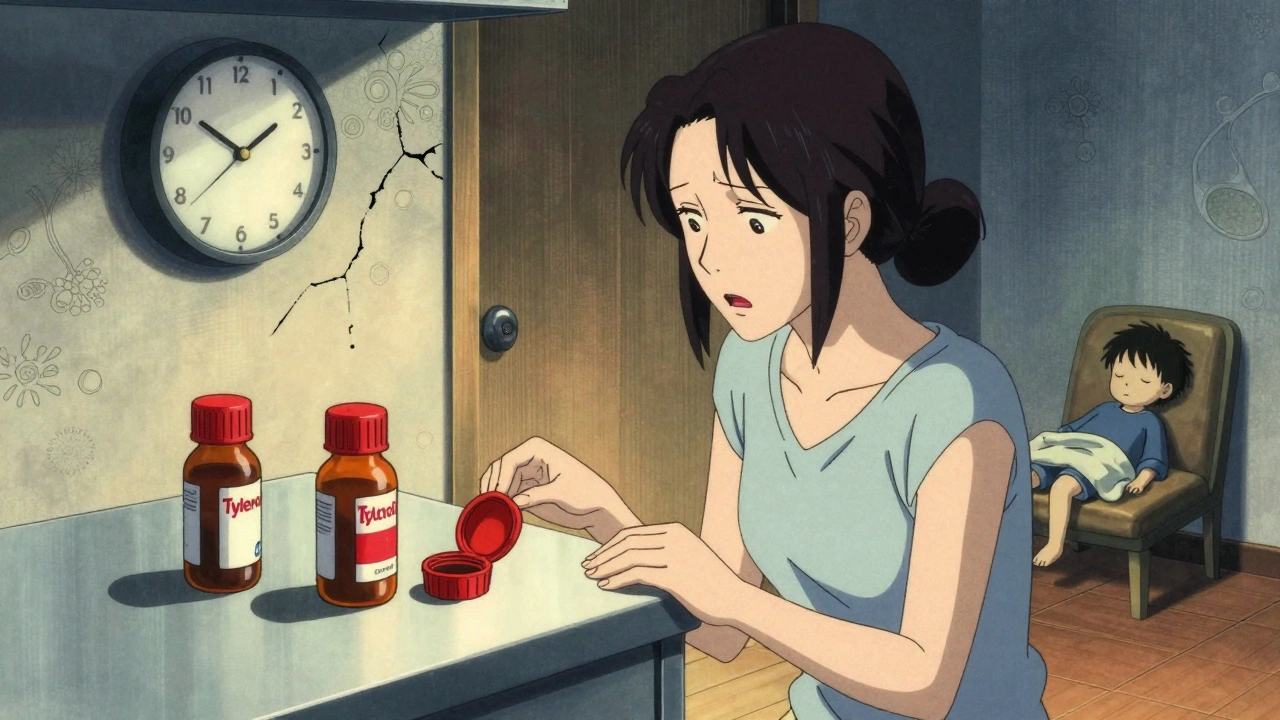
What You Can Do to Prevent Overdoses
Prevention isn’t about being perfect. It’s about reducing chances. Here’s what actually works:- Lock up all medicines. 60% of pediatric poisonings happen at home. A locked cabinet, even a simple one with a childproof latch, makes a huge difference.
- Never call medicine “candy.” Kids mimic what they hear. If you say “this is medicine candy,” they’ll believe it.
- Use the measuring tool that comes with the bottle. A kitchen spoon? Not accurate. A dosing syringe? Much better. Keep it with the medicine.
- Keep a list of all medications your child takes. Include dosages and times. Share this with caregivers, babysitters, and doctors.
- Check expiration dates. Old medicines can break down and become unpredictable.
- Don’t leave pills on counters. Even a single pill left out can be grabbed by a curious toddler.
Child-resistant caps aren’t foolproof. About 20% of poisonings happen even with them. That’s why storage matters more than the cap.
What Happens After You Call for Help?
Once you call poison control or 911, they’ll guide you through what to do next. If you’re sent to the ER, they’ll likely check vital signs, run blood tests, and possibly give activated charcoal to absorb the drug. For acetaminophen, they’ll test liver enzymes and give NAC through an IV. For opioids, they’ll give naloxone and monitor breathing.In most cases, if help comes early, children recover fully. But delays can lead to liver failure, brain damage, or death. Between 2018 and 2022, over 1,500 children under age 5 died from medication poisoning in the U.S. That’s not a statistic-it’s a warning.
There’s also a new tool: webPOISONCONTROL®. It’s a free online system that walks you through symptoms and gives real-time advice for non-emergency cases. You can use it on your phone while you wait for a response. But remember: if your child is unresponsive, struggling to breathe, or having seizures-don’t wait for a website. Call 911.
Why This Keeps Happening
Pediatric medication overdoses are rising. In 2022, over 1 million cases involved children under six. That’s up 7% from the year before. Why? More families are managing multiple medications at home. One survey found 68% of U.S. households keep 10 or more prescription and over-the-counter drugs. With that many bottles around, mistakes become inevitable.Also, more dangerous drugs are showing up in homes. Fentanyl, a synthetic opioid 50 times stronger than heroin, is now found in counterfeit pills sold as oxycodone or Xanax. Even one pill can kill a child. And with medical marijuana becoming more common, pediatric exposures to THC products have jumped 1,475% since 2017.
There’s no single fix. But awareness saves lives. Knowing the signs. Knowing when to act. Knowing where to call.
Final Reminder: Don’t Wait
If you think your child took too much medicine, don’t wait. Don’t watch for symptoms. Don’t hope they’ll be okay. Don’t panic and freeze. Pick up the phone. Call 800-222-1222. If they’re not breathing, not waking up, or turning blue-call 911. Right now.Medicines are powerful tools. But in the wrong hands-or the wrong dose-they become silent killers. Your quick action can stop that.
What should I do if my child swallowed a pill I didn’t know was there?
Call Poison Control at 800-222-1222 immediately-even if your child seems fine. Tell them the name of the pill, how many you think were taken, and when it happened. They’ll tell you whether to monitor at home or go to the ER. Never wait to see if symptoms appear.
Can I give my child ipecac to make them throw up?
No. Ipecac is no longer recommended for home use. It can cause more harm than good, especially with certain poisons like petroleum products or strong acids. It also delays proper treatment. Always follow the advice of Poison Control or emergency responders.
Is it safe to give naloxone to a child who overdosed on opioids?
Yes. Naloxone is safe for children and can reverse opioid overdoses. If you suspect an opioid overdose and have naloxone available, give one dose into the nose or muscle. Wait 2-3 minutes. If there’s no improvement, give a second dose. Call 911 right away-even if they wake up. They may need more help.
How do I know if a medicine has acetaminophen in it?
Look for “acetaminophen” on the label. It’s also listed as “APAP.” Many cold, flu, and pain medicines contain it. Never combine two products that both have acetaminophen unless a doctor tells you to. Always check the active ingredients-not just the brand name.
Can I use a kitchen spoon to measure liquid medicine?
No. Kitchen spoons vary too much in size. A teaspoon might hold 3-5 mL. A dosing syringe or cup that comes with the medicine is calibrated precisely. Always use the tool provided, and never guess the dose.
What if my child only took one extra pill?
One extra pill can still be dangerous, especially for young children or small doses. A single extra tablet of acetaminophen or a high-strength opioid can be toxic. Call Poison Control anyway. They’ll calculate the risk based on your child’s weight, age, and the specific medicine. Better safe than sorry.
Are child-resistant caps enough to keep kids safe?
No. About 20% of poisonings happen even with child-resistant packaging. Kids are clever, and some can open them in seconds. The best protection is storing all medicines in a locked cabinet, out of sight and reach-even if the cap is “child-resistant.”
What should I do if I’m not sure what my child took?
Call Poison Control anyway. Have the container ready, even if it’s empty. Tell them everything you saw: color, shape, smell, any writing on the pill. They can often identify the substance from your description. Don’t wait to be sure-act fast.
Allan maniero
December 2, 2025 AT 20:27Man, I never realized how many OTC meds have acetaminophen in them until I started reading the labels after my niece accidentally got into her grandma’s cold syrup. Now I keep a little notebook in my purse with every med my kids take, including the doses and times. It’s crazy how easy it is to double-dose when you’re tired and juggling three kids and a full-time job. I wish this was taught in every parenting class.
Carolyn Woodard
December 3, 2025 AT 14:17The pharmacokinetics of pediatric hepatic metabolism are fundamentally distinct from adult physiology-particularly with phase II glucuronidation pathways in the liver. Acetaminophen toxicity isn’t merely a dosing error; it’s a metabolic cascade where NAPQI accumulation overwhelms glutathione reserves. The 8-hour window for NAC administration isn’t arbitrary-it’s the kinetic ceiling before irreversible centrilobular necrosis begins. We need better public health framing: this isn’t ‘accidental’-it’s a systems failure in medication literacy.
John Biesecker
December 5, 2025 AT 13:38Bro this hit different 😭 I gave my 3yo Tylenol for fever last week and then gave him the cold medicine later without checking… turned out both had APAP. I panicked for 20 mins then called Poison Control. They were chill as hell, asked me the weight, the time, the bottle, and told me I was fine. But now I keep all meds in a locked drawer. No more guessing. 🙏
Genesis Rubi
December 5, 2025 AT 14:24Why do we even have these meds available without a PhD in pharmacology? In Europe they make you get a prescription for anything with acetaminophen. Here? You can buy 200 pills next to the gum at the gas station. This isn’t freedom, it’s negligence. We need real regulation, not just ‘read the label’ platitudes. Someone’s kid is gonna die because some mom was distracted at Target.
Doug Hawk
December 6, 2025 AT 13:09Just want to add-child-resistant caps are a myth. My 2-year-old opened one in 47 seconds last month. I thought I was being careful. Turns out I was just lucky. Now everything’s in a lockbox on the top shelf. Even the vitamins. Even the CBD gummies I take. Kids are tiny detectives. They’ll find it. Don’t trust the cap. Trust the lock.
Michael Campbell
December 7, 2025 AT 07:16They’re lying about naloxone. It’s just another way for the gov to control us. You think they really care about kids? Nah. They just want you dependent on their system. Let the parents handle it. And why’s everyone so scared of a little extra Tylenol? My kid took 3 pills once and ran around like a maniac. Fine. They’re overreacting.
Saravanan Sathyanandha
December 8, 2025 AT 08:17In India, we often store medicines in the kitchen cabinet because refrigerators are not common in every home. But I now understand the danger-especially with children who are naturally curious. I’ve started using a small metal box with a padlock, and I’ve shared this practice with my neighbors. It’s not just about safety-it’s about cultural adaptation. Awareness must travel with practicality.
alaa ismail
December 9, 2025 AT 19:04My sister’s kid once swallowed a whole bottle of melatonin. Looked totally fine. We called poison control. They said ‘wait 2 hours, watch for drowsiness.’ We did. Kid slept 14 hours straight, woke up hungry. No damage. But I still freak out every time I see a bottle out. This post? Lifesaver. Thanks.
ruiqing Jane
December 11, 2025 AT 04:25If you’re reading this and you’ve ever thought, ‘It’s probably fine,’ stop. Just stop. One extra pill isn’t a mistake-it’s a gamble with your child’s liver. I’ve seen what happens when parents wait. It’s not pretty. Don’t be the person who says ‘I didn’t know.’ You know now. Lock it up. Check the label. Call 800-222-1222. No excuses. Not today. Not ever.
Fern Marder
December 12, 2025 AT 04:42OMG I just realized my night cream has acetaminophen in it?? 😳 I’ve been applying it to my face and my 4yo keeps hugging me… I’m so scared. I’m throwing it out right now. And I’m buying a lockbox. Like, NOW. 🙏 #parentingfail
Anthony Breakspear
December 13, 2025 AT 14:43Look, I used to think this stuff was overblown-until my cousin’s baby nearly died from a fake Xanax laced with fentanyl. One pill. That’s it. Now I don’t let anyone touch my meds-not even my wife. I label everything. I lock it. I carry naloxone in my car. And I talk to every parent I know. This isn’t fear-mongering. It’s responsibility. You don’t need to be perfect. You just need to be ready.