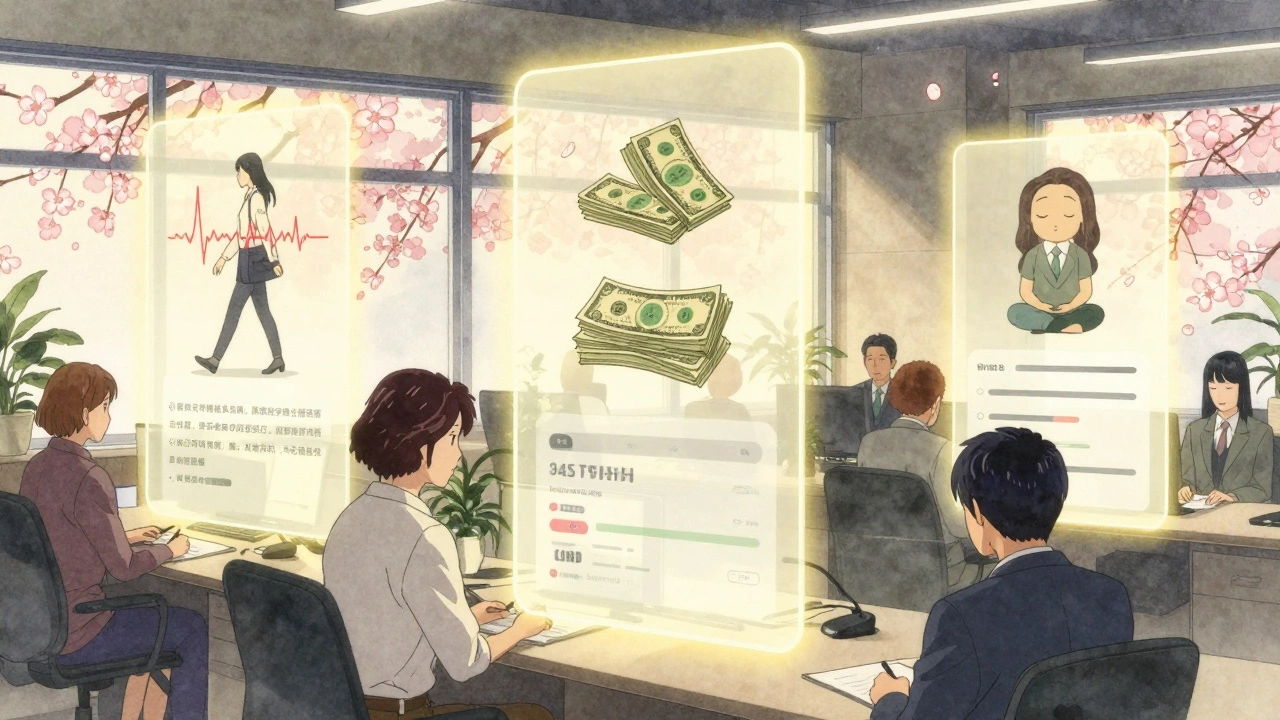
Most companies think workplace wellness is about gym memberships, yoga classes, or free fruit in the breakroom. But here’s the truth: if employees don’t understand why these programs matter to them personally, they won’t care. And they won’t participate. And that means the company’s investment? Wasted.
Back in 2023, a survey by the Kaiser Family Foundation found that 83% of large employers had formal wellness education programs. But only 41% of those programs kept more than half their employees engaged after a year. Why? Because too many companies just send out a generic email titled "Join Our Wellness Program!" and call it a day. That’s not education. That’s noise.
What Workplace Wellness Education Actually Means
Workplace wellness education isn’t just telling people to drink more water or take the stairs. It’s clearly connecting everyday activities - like walking meetings, mental health days, or using a fitness app - to real outcomes that affect their lives. That means explaining how reducing stress lowers blood pressure. How skipping lunch breaks increases the chance of burnout. How enrolling in a financial planning workshop can cut monthly anxiety by 40%.
The CDC’s Work@Health Program, launched in 2012, was one of the first to push this idea. It didn’t just offer resources - it taught employers how to explain the dual value: how wellness helps the employee and how it helps the business. That’s the key. Employees don’t care about corporate ROI. They care about their premiums, their energy levels, their sleep, their ability to pick up their kids from school without feeling exhausted.
Why Generic Messages Fail (And What Works Instead)
Generic messaging gets 19% engagement. Personalized communication gets 68%. That’s not a small gap. That’s a chasm.
One HR manager in Ohio shared on Reddit that after switching from bland monthly newsletters to personalized benefit statements - showing each employee their estimated annual savings on healthcare if they completed certain wellness activities - participation jumped from 32% to 67% in six months. Why? Because suddenly, it wasn’t abstract. It was $217 off their next insurance bill. It was 12 fewer sick days a year. It was being able to take a mental health day without guilt because they knew it was backed by data.
Companies like Johnson & Johnson have built their reputation on this. Glassdoor reviews for their wellness program average 4.2 out of 5, with employees specifically praising how clearly they explained how wellness activities translated into lower premiums and better coverage. Contrast that with a Trustpilot review from someone who signed up for a wellness program that promised $1,200 in annual savings - but only saw $217 after 18 months. That’s not just disappointment. That’s betrayal.
The Seven Dimensions of Real Wellness
Most wellness programs focus on just one thing: physical health. That’s like trying to fix a car by only checking the tires. The Wellness Council of America (WELCOA) created the 7 Dimensions model to fix that. It includes:
- Physical (exercise, nutrition)
- Emotional (stress management, therapy access)
- Social (team connection, belonging)
- Financial (budgeting tools, debt counseling)
- Community (volunteering, local engagement)
- Purposeful (meaning in work, career growth)
- Professional (skills development, workload balance)
Programs using this full model see 34% higher participation than those stuck on just fitness. Why? Because financial stress is the #1 concern for 68% of employees, according to PwC’s 2024 survey. If you’re not talking about student loans, emergency funds, or retirement planning, you’re missing half the battle.

How to Build an Education Plan That Works
There’s no magic bullet. But there is a proven timeline.
The CDC recommends a 12-month rollout:
- Months 1-2: Get leadership on board. If managers don’t talk about wellness, employees won’t believe it’s real.
- Months 3-4: Survey employees. What do they actually care about? What’s stopping them from participating?
- Months 5-8: Roll out education in phases. Don’t dump everything at once. Start with mental health and financial wellness - the two biggest pain points.
- Months 9-12: Measure what worked. Track participation, healthcare claims, absenteeism, and survey feedback. Then adjust.
Successful programs spend 3-5% of their total wellness budget on education alone. That’s not an expense. That’s insurance. Without it, you’re gambling that people will figure it out on their own.
Technology and Personalization Are No Longer Optional
AI-driven personalized benefit statements are no longer futuristic. Forrester predicts 45% of large employers will use them by 2026. Right now, only 12% do.
What does that look like in practice? Imagine an employee logs into the company portal and sees: "Based on your age, family size, and current activity level, completing 10 wellness activities this year could reduce your annual healthcare costs by $412. You’re currently on track for $287. Here’s what you can do next."
That’s not spam. That’s insight. And it’s working. Personify Health found that combining email, intranet posts, manager talking points, and personalized statements boosted engagement by 53% compared to using just one channel.
Smaller companies (under 50 employees) often think they can’t afford this. But that’s not true. Basic wellness education modules start at $495 per employee annually. For a 20-person team, that’s under $10,000 - less than the cost of one new hire’s onboarding. And the ROI? Harvard Business Review studies show $3.27 returned for every $1 spent.

The Legal Tightrope
Here’s the ugly truth: if you’re not careful, your wellness program could get you sued.
The EEOC received 2,147 wellness-related complaints in 2023 - up 37% from the year before. Why? Because many programs ask health questions or require medical tests to get discounts. That’s illegal under the ADA and GINA unless it’s truly voluntary and the incentives stay under 30% of the total health plan cost.
SHRM updated its certification program in October 2024 to include EEOC compliance training. If you’re offering incentives - a discount on premiums, a gift card, extra PTO - you must make sure they’re not coercive. And you must clearly explain what data you’re collecting and how it’s being used.
Non-compliance can cost up to $119,556 per affected employee. That’s not a risk worth taking.
What Happens When You Get It Right
Companies with strong wellness education don’t just save money. They become places people want to work.
Mercer’s 2023 survey found employers with comprehensive education saw 11% lower turnover. SHRM’s 2024 report showed 27% higher engagement when communication was multi-channel. And Dr. John Howard from NIOSH says clear benefit communication is the single biggest predictor of sustained participation - increasing year-over-year engagement by 42%.
It’s not about having the fanciest app or the most expensive gym membership. It’s about making sure every employee knows exactly how their participation changes their life. Not in five years. Not in theory. Right now.
When an employee sees that their weekly walk with a coworker cuts their risk of heart disease by 18%, or that their mindfulness app subscription reduces their anxiety scores by 30%, they don’t just join the program. They own it.
Final Thought: It’s Not a Program. It’s a Conversation.
Workplace wellness education isn’t a one-time launch. It’s an ongoing dialogue. It’s managers asking, "How’s your sleep been?" It’s HR sending a quick video explaining how the new mental health benefits work. It’s a manager who takes a mental health day and says, "I’m doing this because I need to recharge - and you should too."
When wellness becomes part of the culture - not just a brochure - people don’t just participate. They thrive.
Chris Park
December 6, 2025 AT 06:00Let me guess - the CDC’s Work@Health Program was funded by Big Wellness™ and the pharmaceutical lobby. 83% of employers have these programs? Of course they do. They’re not trying to help employees - they’re trying to shift healthcare costs onto workers while pretending it’s ‘care.’ You think $217 off insurance is a win? That’s a 12% discount on a $1,800 premium. They’re giving you crumbs so you stop asking why your deductible is $7,500. And don’t get me started on the ADA violations - if you’re tracking sleep patterns or stress levels via an app, you’re violating Title I. They’re not educating you. They’re surveilling you. And you’re applauding.
Ashish Vazirani
December 7, 2025 AT 04:52India has been doing this since 2010 - and no one here cares about your ‘personalized benefit statements’! We have 12-hour workdays, no mental health days, and our HR departments don’t even know what ‘wellness’ means beyond ‘drink more water.’ You think $495 per employee is affordable? In Mumbai, that’s a month’s salary for a junior clerk. And you want us to track ‘purposeful’ work? Ha! We’re lucky if we get paid on time. Your ‘7 Dimensions’? We’re stuck on Dimension 1: Survive. Your ‘ROI’? We’re surviving on chai and desperation.
Billy Schimmel
December 8, 2025 AT 07:36Wow. So you’re saying if I walk to the fridge instead of waiting for the elevator, I save $412 a year? That’s… actually kind of cool. I mean, I didn’t know my 3pm stroll to the vending machine was a ‘wellness activity.’ But hey, if it cuts my premium, I’ll start doing it while yelling at my Fitbit. Thanks for making me feel like a genius for breathing.
Clare Fox
December 9, 2025 AT 03:22i think the real problem is we’ve turned wellness into a checklist instead of a way of being. like… why do we need a program to tell us to sleep better? or to take breaks? or to not work 80 hours a week? it’s not about the app or the $217. it’s about whether the culture lets you be human. if your boss still texts you at 11pm… none of this matters. the ‘conversation’? we don’t even have the silence to have it.
Akash Takyar
December 10, 2025 AT 06:02Excellent and well-researched analysis! The 7-Dimensional model is not merely theoretical-it is empirically validated across multiple multinational corporations in Asia and North America. The key lies in sustained, multi-channel communication, and the integration of managerial accountability. I strongly recommend that organizations adopt a phased rollout as outlined, with quarterly feedback loops and transparent reporting on participation metrics. The ROI is not speculative-it is documented, measurable, and transformative.
Kenny Pakade
December 10, 2025 AT 16:48Oh wow, another corporate PR piece disguised as ‘insight.’ Let me guess-Johnson & Johnson’s program is just a cover so they can fire people who don’t hit their step goals. And you think ‘personalized statements’ aren’t just data mining with a smiley face? You know what’s cheaper than $495 per employee? Not hiring people. That’s what the real ROI is here. You’re not saving money-you’re just making workers feel guilty for being tired. And don’t even get me started on the ‘EEOC compliance’ part. That’s just legal theater. They’ll find a loophole. They always do.
brenda olvera
December 11, 2025 AT 15:01my abuela used to say if you eat well sleep well and laugh with your people you dont need no wellness program. we dont need apps or statements or dimensions. we need to stop being treated like machines. if your company cares about your sleep then why are you still getting emails at midnight? why are you still afraid to take a mental health day? this whole thing feels like putting a bandaid on a broken leg and calling it medicine
olive ashley
December 11, 2025 AT 20:27you know what’s funny? the same companies pushing this ‘wellness education’ are the ones cutting mental health coverage last year. they’re not trying to help you-they’re trying to make you *feel* helped so you don’t sue them. that $217 savings? it’s not real. it’s a math trick. they add up all the people who did nothing and say ‘see? 67% engagement!’ but half of those people just clicked ‘yes’ to get the $10 gift card. and now they’re tracking your keystrokes to see if you’re ‘productive’ during your ‘mindfulness break.’ this isn’t wellness. it’s control dressed in yoga pants.